Sunday, February 18, 2007

Fra Angelico

I'm just too busy to post anything. The Franciscans told me today that it was the feast day of Blessed John of Fiesole, otherwise known as Fra Angelico. Enjoy the painting -- it was one of my favorites from the Prado in Madrid.

There's a lovely story about Fra Angelico by Antonio Tabucchi for those who can read Italian.

Monday, February 05, 2007

the martyrdom of Saint Agatha

A traditional representation of St Agatha, with a martyr's palm and a dish containing her breasts.

It seems whenever I decide to write about a certain saint, Crystal scoops me. Check out her page for some information on the legend as well as for an interesting interpretation of St Agatha by the contemporary Canadian artist Jennifer Linton. I would just like to jot down some reflections on the legend and representation of today's saint.

St Agatha is one of a number of early Christian virgin martyrs who was killed after refusing marriage or sexual advances from pagan Roman officials. In her story, she is forced into a brothel and when she refuses to accept customers, she is tortured and her breasts are cut off. The sadistic eroticism is explicit in this tale and is part and parcel of the efforts of the Roman official, Quinctianus, to demand sex of her and then force her to work in a brothel. The amputation of her breasts are the finishing touch of male assault on her body, a long, drawn-out act of rape. St Agatha, however, is not vanquished, and reclaims her own body, reminding Quinctianus that a woman's breasts are more than objectified erotic objects: "Cruel man, have you forgotten your mother and the breast that nourished you, that you dare to mutilate me this way?" Or, in the fifteenth-century English of the William Caxton, the first translator of the medieval Golden Legend:
Over felon and cruel tyrant, hast thou no shame to cut off that in a woman which thou didst suck in thy mother, and whereof thou wert nourished? But I have my paps whole in my soul, of which I nourish all my wits, the which I have ordained to serve our Lord Jesu Christ, sith the beginning of my youth.
This story seems very profound to me, and St Agatha's ability to reinterpret Quincianus' narrative by a more thorough knowledge of her own body as well as her understanding that faith preserved her physical integrity (she does not claim that her body is harmed but that her soul is whole, rather she claims "I have my paps whole in my soul") shows her to be very powerful.

St Agatha is often represented in devotional art with her breasts on a plate, and we moderns may either giggle like schoolchildren or turn away horrified. Are these images truly that morbid, or are we disturbed because we are uncomfortable with our own physicality? Martyrs usually bear the symbols of their martyrdom as trophies -- St Catherine of Alexandra carries the wheel with which she was tortured or the sword with which she was murdered; St Lucy holds a plate holding two eyes, since her eyes were gouged out by her tormentors. Sometimes St Agatha is just represented with the pair of shears or tongs that were used to remove her breasts. They are symbols, and the saints are represented as healed and whole -- "whole in their soul," as Agatha might say.

Renaissance and especially Baroque art change this equation and play with the human drama involved in the story. In the "Martyrdom of St Agatha" by Sebastian del Piombo (c. 1485 - 1587), we are presented with the very brutal scene in which the tongs are applied to Agatha's breasts. She is nude to the waist, and the erotic element seems very clear. Is Agatha allowed to redeem herself in this painting?

In Tiepolo's eighteenth-century version, there is another twist on the iconography. In his painting, there is a dish with two breasts on it, but it is not merely symbolic, for we see Agatha press a bloody cloth to her chest and we realize the intense physicality implied in the traditional representation of the saint.

In another representation, we see a portrait of an aristocratic lady, possibly by Sebastian del Piombo, in which the dish with breasts, the shears, a halo, and a martyr's palm had been added at a later date. In a weird way, a realistic portrait has been given the timeless symbols of a martyr's icon.

Tuesday, January 30, 2007

cor bestiae devoravimus

Samarkand, great city of the Silk Road in Uzbekistan.


Sometimes you find yourself wandering through the far reaches of Queens carrying an umbrella and a wedding dress, looking for Uzbek food.

Let me explain, though it be a long story. Imperatrix pulcherrima Africae occidentalis had a knee operation a year ago and I found myself in the position of nurse (I'm sure everything would have been better had she followed my advice and let me perform the surgery at home with a corkscrew and a rubber band, but...). I asked in return Uzbek food, since I had read there were so many Uzbekis in Rego Park, Queens that the area is often referred to as "Regostan."

Things move slowly. A year later, Imperatrix pulcherrima Africae occidentalis had healed from her operation and had been proposed to. She had Martin Luther King Day off and we went to Queens to pick up the wedding dress she had picked out the day before (Imperatrix pulcherrima Africae occidentalis has been handling the wedding preparations with ruthless efficiency). So we decided that afterwards we would follow the "R" train out to Rego Park in eastern Queens so I could finally cash in on the Uzbek food. We went to the bridal store where I looked away from the dress, lest I be blinded, held out my credit card, and paid extra money for a bag that would keep me from seeing the dress by mistake. I then draped it over my umbrella and we set out for the Silk Road, New York City.

The restaurants in Regostan are all kosher (which I love, since I'm allergic to shrimp and I never have to worry about eating it by mistake in kosher restaurants). This is because most of the central Asians who have come to Regostan are Bukharian Jews, who trace their origins back to the Babylonian captivity, and 90% of whom have emigrated to Israel and the United States since the fall of the Soviet Union.

Bukharian Jews, circa 1890.

The Bukharian Jews spoke their own language, a mix of Hebrew and Persian, and lived a culture that went back thousands of years.

After a bit of googling, I had settled on a restaurant called Cheburechnaya. Unfortunately, the one website that gave a subway stop gave the wrong one, and so we had quite a walk to the restaurant carrying a heavy wedding dress. We finally made our way down 63rd Drive, a commercial street with signs in Russian and English. We reached Cheburechnaya, a brightly-lit place with a big neon sign across the street from an old white wooden Lutheran church that must have been built in a very different kind of neighborhood.

We sat down at the table and looked around us. I believe we were the only non-Bukharians there. The televisions displayed Russian music videos. We carefully examined the menu (warning to Crystal and Sandalstraps and other vegetarians: strange animal parts to be featured). We started with soup. Imperatrix pulcherrima Africae occidentalis had a succulent and filling oxtail soup (shurpa), and I had lagman, a soup with a Silk Road connection -- lagman is apparently connected to Chinese lo mein, and features wonderful handmade noodles and delicious broth. We also had cheburikis, pastries filled with mushrooms and cabbage.

Then it was time for the meat. The restaurant offers a number of kebabs on big sword-like spits. We ordered three. Lulya (a kind of spiced meatball), veal sweetbreads, and...


LAMB'S HEART ON A STICK!


That's right. We devoured the heart of the beast and took from it its strength. Unfortunately, it wasn't still beating when we gnashed it to pieces with our teeth, but the good thing was that, like any other part of a lamb, it tasted like lamb. It was good. It wasn't the funkiest lamb part on the menu, either.


We both enjoyed the lulya. I liked the sweetbreads, but Imperatrix pulcherrima Africae occidentalis was not as enthusiastic about its texture. It is the animal's pancreas, after all ("A certaine Glandulous part, called Thimus, which in Calues... is most pleasaunt to be eaten. I suppose we call it the sweete bread..." John Banister, The historie of man, 1578. Thank you, OED). I found it very tasty. It melts in one's mouth.


I do regret we didn't try one of the salads, it would have gone well with the meat. We washed the whole thing down with gallons of green tea, had a lovely almond cake dessert, paid the ridiculously small tab, and left, a wedding dress in our arms and a desire to return for more in our hearts. The Uzbeck food adventure had been thoroughly successful.

Tuesday, January 23, 2007

Silly

Jean Fouquet. Portrait of the Ferrara Court Jester Gonella. c. 1442. Tempera on wood. Kunsthistorisches Museum, Vienna, Austria.

Sometimes quite by chance I come across evidence of what an unapologetically silly person I can be. Today, when trying to figure out how to use MS Access to print out reports on my charters, I came across a nonsense database I created when first learning to use the program, the "database of desire." I had wanted to have one large text field since I knew I would be typing in extensive notes on my charters, so I created a field of fake novel excerpts. Without further ado, I present them for your reading enjoyment:

She was dark, dark like the night. O! that I could know her, touch her cabbages, call her Tiny Jim…

Gretel held the ostrich egg in her hand, wondering how many people she could feed after frying it sunnyside up. What are we talking about here -- she thought to herself -- dinner-plate size? Pizza size? Hula-hoop size?

"No!" She shouted, her eyes blazing in righteous nausea….

Green, green flowed the lawnmower over her heart of bliss. Ach! Bitter was the schweingartenmeister…

How high the moon? Not high enough, he said, sadly, drinking his pesticide and gin.

The football cruised to an uptight velocity and then turned ever so slightly, as if to graze the cleavage of the Romanian cheerleader. That was the sign that blood rains would drench the field before the third quarter….

We knew then that there would be no giving up, no time for sniffling, just a moment before the shell broke on the counter, covering the kitchen floor in unbeaten ostrich egg…

The ides of march fell on a Tuesday that year, which surprised everyone in the gallery…

That was the year we were going to make it to the finals that year, but our star forward was trapped in the desert and had to eat his own foot…

My mind was floating across the idea that I would never see her again, when the shark shook me out of my musings...

Thursday, January 18, 2007

Five things you perhaps do not know about me

One thing you didn't know about Emperor Frederick II -- he played basketball (the ball is in his left hand).

It seems that the only thing that will get me off my fat Irish butt and blog is to be tagged for a meme. Talmida hit me with this one. Let's see how many of you know these things (or if you care).

1. I'm getting married. Yes, it's true. I kept planning to make a formal announcement on the blog and I never got around to it. Imperatrix pulcherrima Africae occidentalis and I are tying the knot next October. I proposed to her last September at the Cloisters after an elaborate ruse which successfully aimed at taking her off guard and thus confusing her to the point at which she would say yes.

2. I can play several instruments very badly. Over the course of my life I have taken lessons in piano, trumpet, guitar, saxophone, cello, and accordion (from a Bulgarian in Madrid) -- never at the same time. I have a four-track recorder (now gathering dust at my mother's house) and at one point I recorded songs, accompanying myself on guitar, bass, accordion and percussion (a plastic box of dry lentils -- ker-SHUNK). Alas, my love of music was never matched by my talent.

3. As a child I met John Wayne. He was a friend of a client of my father's, and we met him in central Utah. I may meet men who are taller and men who are fatter, but I will never meet a man as big as John Wayne.

4. When I was fourteen, I wanted to be an actor. My uncle is a playwright and theater has always been in my life. In fourth and fifth grade, I wrote the school play and as a teenager I was acting in plays my uncle produced (for example, we did a fifteen-minute version of Richard III on the city buses). An actor, however, uses his body as an instrument, and I'm afraid I have always been a bit too clumsy to be at ease on stage. The last thing I was in was a bilingual production of The Tempest in Madrid. It was good training for my voice, though, and I do fairly well at public speaking -- lecturing, doing poetry readings, or being a lector at church.
5. I shot a man in Reno just to watch him die. Okay that's not true... Let me try again.

5. In my past lives, I was an Egyptian pharaoh, a Roman poet, a Templar, and an Elizabethan explorer. Okay, that's not true either. I don't believe in reincarnation, but if I did have past lives, odds are I would have been one of the 99.99% of humanity that throughout history spent their time shoveling cow poop.

5. I was briefly married to Mae West. No, that's not true either.

5. I make a mean roast chicken. That is actually true. A very good roast chicken.

Who shall I tag? Well, let's say Jeff, Sandalstaps, Guillaume le Fou, and mi primo.

The engagement ring.

Thursday, January 11, 2007

Prayer

Caravaggio, St Catherine of Alexandria.

Crystal has tagged me for a contemporary theology meme, which is a bit of a problem for me since I found my way back to the Church while in grad school and thus have had very little time to read things not written in or about the Middle Ages. I will give it some thought.

Meanwhile, I finished adding all of Queen Urraca's charters to my database and decided to celebrate by wasting time bouncing around the internets. I hit beliefnet and came across a couple of articles on praying for a parking place. One, by Patton Dodd, was very serious and its general tone was summed up in its title: Praying for Parking is Evil. The author's point was that a God who will find you parking but won't stop the Holocaust leaves something to be desired, and seen from that perspective it's difficult to argue with him. In the end, though, it seems terribly rigid and gloomy -- we all have to be very serious about this and frivolity is morally dangerous. The specter of Puritanism rears its dour head.

The other article, by Father James Martin, is on the opposite side of the spectrum, investigating what saints are to be prayed to for finding lost items:
St. Anthony, St. Anthony, please come around.
Something is lost but cannot be found.
Or finding a husband:
St. Catherine, St. Catherine,
O lend me thy aid.
And grant that I never shall die an old maid.

Or even finding a parking place:
Mother Cabrini, Mother Cabrini,
please find a spot for my little machiney.
Of course, serious Christians will scowl and say that the two articles cannot be compared. Dodd's article is theological, whereas Martin's is folkloric. It goes along with memories of the Irish nuns teaching school and long-away Sundays when we were altar boys. At worst it's superstitious and at best frivolous. It helps us in no way spiritually.

Or does it? Why is the playful excluded from the spiritual? The center of my own understanding of God is apophatic (as I understand that term) -- I think God is beyond our comprehension. This does not make our ways of approaching God (scripture, liturgy, theology) invalid, but we cannot approach God without our limitations. On one hand, it is important to be rigorous and use our intelligence to clarify what we mean when we speak -- we were given intelligence for a reason, after all. Also we must make moral choices based on love of God and our fellow human beings. There is, however, a kind of arrogance in being too rigid and judgmental. We must remember how limited even our greatest flights of understanding are.

I believe many of our traditions have grown around deep psychological and spiritual needs that we have, and to reject them out of hand because they do not fit a limited understanding of scripture or theology will impoverish our spirituality. Veneration of saints is a good example. Yes, if we forget Christ because we only concentrate on saints, or if we feel that a prayer is magic spell that can compel heavenly action, we are probably wandering away from where we should go. Yet praying to saints is also a way of responding to the feeling that we are in a Church, a community, that includes the living and the dead, and that after the incarnation the distance between human beings and God has been bridged.

I love reading Aquinas and other theologians because there is something magnificent in the edifices they build when they apply reason to religion. There is something holy in it as well, but it's only a part. The core is mystery. I have an acquaintance who called mystery the perennial Catholic cop-out, but to me I can't really believe that, in the end, we can completely understand the divine with our heads. That conditions how I see intercessory prayer, a subject which creates a theological difficulty. After all, if God is perfect and how God acts is perfect, how could we move God to change the way he/she is working in the world? As Dodd suggests, what kind of a God finds parking spaces but ignores our pleas for peace in Darfur? On the other hand, what kind of God does not listen to the cries of his/her children?

The question ends, like most others, in mystery. I see intercessory prayer as hope made active before God. Hope, we are told, is a virtue whereas despair is a sin. If we do not express our hope to God, to whom will we? Like thanking and praising, expressing hope in the form of prayer is a basic way of behaving towards the divine. How it functions -- where, when, why and if God intercedes in our world to change it in the direction we hope it to change -- is a mystery. Still, it would be foolish not to hope.

This includes frivolous and playful hopes as well, which can be expressed in playful ways, such as in the rhymes above. It is true if you spend all your time hoping for the superficial, you become superficial, and if your hope becomes vain desire, you're setting yourself up for disappointment. Still, playfulness is part of life and I believe the playful has its place in the spirit.

Friday, January 05, 2007

Año nuevo, vida nueva

Happy New Year, everyone. I have returned from the Western mountains, where Imperatrix pulcherrima Africae occidentalis and I did little more than sleep, eat, and lay about, which was pretty much what we needed to do. Now I am ready to attack the charters with renewed vigor, and I hope that I can organize the rest of my life as well. I won't be as foolish as to state resolutions here on the blog that could come back to haunt me, but I do hope to write a bit more. We'll see.

Friday, December 22, 2006

Merry Christmas!

The Angel appears to the shepherds, San Isisdoro, Leon, Spain

Et pastores erant in regione eadem vigilantes et custodientes vigilias noctis supra gregem suum et ecce angelus Domini stetit iuxta illos et claritas Dei circumfulsit illos et timuerunt timore magno et dixit illis angelus nolite timere ecce enim evangelizo vobis gaudium magnum quod erit omni populo quia natus est vobis hodie salvator qui est Christus Dominus in civitate David et hoc vobis signum invenietis infantem pannis involutum et positum in praesepio et subito facta est cum angelo multitudo militiae caelestis laudantium Deum et dicentium gloria in altissimis Deo et in terra pax in hominibus bonae voluntatis

Now there were shepherds in that region living in the fields and keeping the night watch over their flock. The angel of the Lord appeared to them and the glory of the Lord shone around them, and they were struck with great fear. The angel said to them, "Do not be afraid; for behold, I proclaim to you good news of great joy that will be for all the people. For today in the city of David a savior has been born for you who is Messiah and Lord. And this will be a sign for you: you will find an infant wrapped in swaddling clothes and lying in a manger." And suddenly there was a multitude of the heavenly host with the angel, praising God and saying: "Glory to God in the highest and on earth peace to those on whom his favor rests."
Luke 2:8-14


Giotto, the Nativity. 1304-1306. Fresco. Capella degli Scrovegni, Padua, Italy.

HAVE A MERRY AND BLESSED CHRISTMAS, EVERYONE!

Tuesday, December 19, 2006

Christmas Meme

Ivory Nativity, Salerno (eleventh century).

I've caught another meme, this time thanks to Jeff. Of course, Guillaume le Fou, who has too much time on his hands now that he has abandoned civilization for Long Island, got to it first and has been terribly clever, though he was not as quick on the draw as Crystal.


1. Egg Nog or Hot Chocolate? Hot Chocolate says "winter" to me in general, but doesn't connote "Christmas" in particular. I do enjoy egg nog on Christmas Eve, before we go to bed, still dressed up from Midnight Mass. Bourbon and nutmeg are essential ingredients.

2. Does Santa wrap presents or just sit them under the tree? When I was a child, he sat them under the tree. This is actually the first Christmas I shall spend in loco parentis with Filio imperatrix pulcherrima Africae occidentalis, and I understand Santa will be wrapping presents.

3. Colored lights on tree/house or white? Hmm... This year we didn't put up a tree, because we're going to Utah for Christmas. At my house we always went for colors.

4. Do you hang mistletoe? I considered just wearing mistletoe on the top of my head, but since I
mperatrix pulcherrima Africae occidentalis seems willing to kiss me without it, I think I won't go through the bother.

5. When do you put your decorations up? Last year, at the beginning of December. This year I put out some Advent candles and an Advent calendar, but I haven't had time to buy a wreath for the candles and we're about a week behind on opening the wee doors on the Advent calendar. My life is like this. Don't even ask me about my dissertation.

6. What is your favorite holiday dish (excluding dessert)? Stuffing. I would support the genetic engineering of a turkey that could hold thirty cubic feet of stuffing, and damn the consequences.

7. Favorite Holiday memory as a child: I remember getting up on Christmas and dying with anticipation. The door to the living room where the presents were would be closed, and I would have to wait for all the houseguests -- my great aunts, my grandparents -- to get up and have their coffee. I, the youngest child, bounced off the walls. Then the door would be opened...

I also remember my grandfather telling me he had awoken at night during Christmas Eve and had seen Leprechauns dancing across the bed. I have no idea what that would have to do with Christmas, but it seemed to add a nice bit of Irishness to the Santa magic, so I was very pleased to hear it.

8. When and how did you learn the truth about Santa? You mean that he was at the Council of Nicaea? I think I figured that one out when reading for my PhD orals exams. I already knew about the North Pole, elves, and reindeer, and strangely was not tested on that information by my orals committee.

9. Do you open a gift on Christmas Eve? No. Be patient.

10. How do you decorate your Christmas tree? As best as possible. I look forward to slowly acquiring a set of meaningful ornaments with my family.

11. Snow? Love it or Dread it? I grew up in Utah and Christmas is sadly lacking when there is no snow. I even like snow in New York -- for the first couple of days, until it turns every color except white.

I remember one Christmas there was a heavy snowfall and Santa had brought cross-country skis to my father and brother. My brother and I put them on and skied around the neighborhood under the moonlight quiet and the softly falling snow.

12. Can you ice skate? I haven't done it since I was a child, in a rink now long demolished. I enjoyed it, but I never learned how to skate backwards. Now I need to wear braces on both my ankles when I play basketball, so I'm not sure how long I would be able to skate without incurring injury. I would like to go to the rink in Rockefeller Center or Central Park sometime, though.

13. Do you remember your favorite gift? I remember an exceedingly cool and big helicopter for my GI Joe. It was yellow and the propellers would move when you pushed a button on the side. I also remember my mother gave me a tweed jacket, black turtleneck, and beret one year. I looked like a thirteen-year-old French existentialist.

14. What's the most exciting thing about the Holidays for you? The general excess of food, drink, gifts, and laughter with my family. Apart from that, and despite the craziness, I enjoy midtown New York at Christmastime. The tree and the skating rink at Rockefeller Center, the shop windows that I look at from a distance to avoid the crowd, the brass bands playing Christmas carols on Fifth Avenue... I'm a sucker for it all.

15. What is your favorite Holiday Dessert? I don't have much of a sweet tooth, but I will never turn down pumpkin pie. When I'm in Spain, marzipan candy.

16. What is your favorite holiday tradition? Our huge Christmas breakfast. Eggs, sausage, bacon, steaks, rolls, champagne, Bloody Marys... Then we are comatose until dinner.

17. What tops your tree? An angel, if I recall correctly.

18. Which do you prefer - giving or receiving? I love presents in general. I love giving things, especially when I hit on the perfect gift. I like getting presents as well -- not so much because I like to have stuff, but I love the surprise of seeing what someone has gotten for me.

19. What is your favorite Christmas Song? Adeste Fideles. It's a great tune and in a great language. I enjoy "Angels We Have Heard on High," because it's lovely and also has nice rousing Latin bits. Of course, "O Holy Night" and "Silent Night" are gorgeous, especially when sung by a good singer.

On the other hand, "Santa Claus is Coming to Town" scares the hell out of me.

20. Candy Canes? No, not really. It's nice to see them around, but I can do without them. They always went uneaten in my house when I was a child.

Thursday, December 07, 2006

feast of St Ambrose

St. Ambrose.

This is not really a responsible post. This is just me checking in. You see, I have been tremendously productive with the charters this week, but it has left little time for blogging. So I will just link you to other people who have been writing worthwhile posts.

I will say little more about dear St. Ambrose. As usual, I leave you with the Franciscans at American Catholic for more information. I was going to write about St. Nicholas yesterday, but Crystal scooped me with a great post on St. Nick's final resting place. What she didn't mention was (I believe I'm remembering right) Nicholas, the bishop of Myra, was present at the Council of Nicaea in 325. So next time you recite the Nicaean creed, remember that Santa Claus was involved in its creation.

I haven't been to Bari, but I have been to Milan and I have seen the tomb of St. Ambrose. He's a bit thin, but all in all he looks pretty good for someone who's been dead for 1,600 years.


The tomb of St. Ambrose in Milan.

Speaking of relics, there is a post in dotCommonweal on a boycott of Ebay called by some Catholics who were distressed by the sale of relics on that website. Really everyone, we've been trying to regulate all of this since the Fourth Lateran Council in 1215. Buy your relics from an authorized dealer.


Guillaume le Fou has written a wonderful post about a woman who probably should be a saint, but isn't. I don't know about her relics. Jeff has written a great piece on Iraq, which should be required reading.

That's all for now, I must get back to my charters. Enjoy the links.

Tuesday, November 28, 2006

reading charters with one's heart

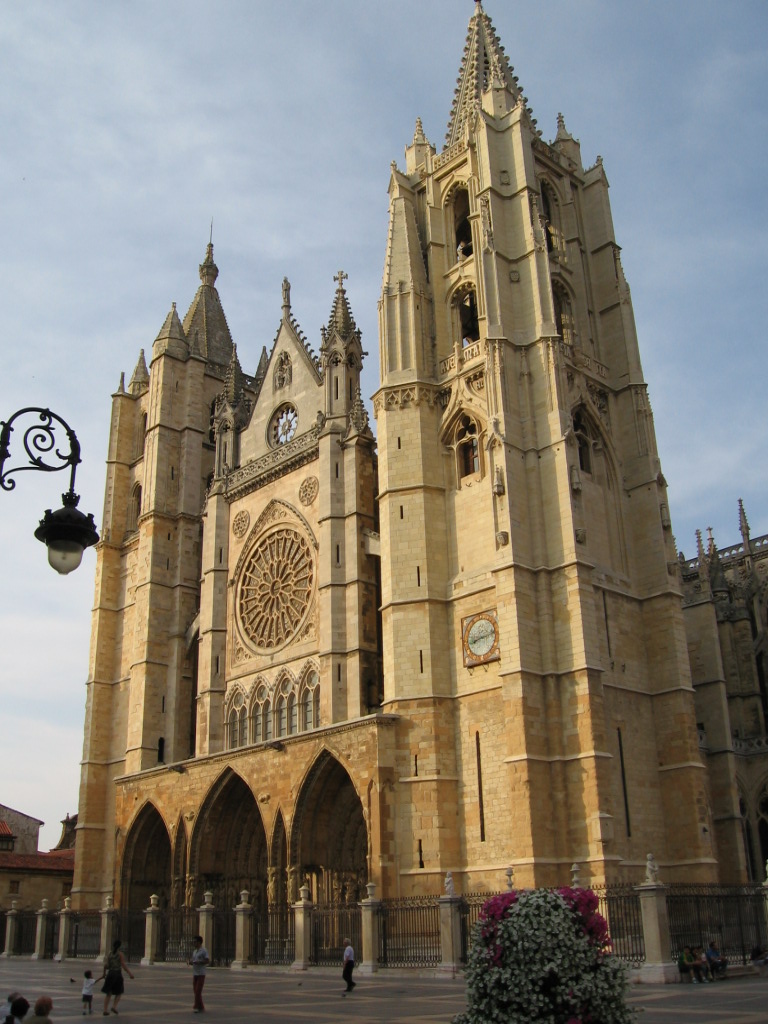
Leon, cathedral. Photo by Trepanatus.

Let's face it, the charters I read are not always the most exiting documents. Sometimes they're as dry as week-old toast. So, my imagination takes over and usually I turn the charters into conversations. The boring and legal charter of Alfonso VI #131 becomes, in my mind, the following conversation:

Alfonso: "Dude, I'll give you one tenth of all the cows I own in Somoza if you pray for my victory over the Ishmaelites."

Bishop Pedro of Leon: "Cool."


Sometimes I get a whole scenario from one bit of text.

For example, Alfonso breaks me up. He (his scribe, really) dates one charter as: "Regnante et imperante ego me medipso in Toleto et in Legione," etc. That's like saying "Reigning and commanding me, myself, and I in Toledo and in Leon," etc.


I can just see him having dinner with Queen Constance.

Alfonso: "Hey Connie, you know who's king?"

Constance (familiar and bored with this game): "Who, Al?"

Alfonso: "I am!"

He laughs, she sighs. A pause.

Alfonso: "You know who else?"

Constance (stifling a yawn): "Who, Al?"

Alfonso: "ME!"

He can't contains his giggles. Another pause.

Alfonso: "You know who else?"

Constance (distracted, picking at quail bones): "Who?"

Alfonso: "Myself! Isn't that a riot?"

Constance: "Are you going to eat that last quail leg?"

Tuesday, November 21, 2006

fado

Portuguese manuscript from 1189.

Crystal posted on David Hart and Voltaire, commenting in passing on one of the cities most dear to me, Lisbon. This led me to think of the beautiful, sad Portuguese song known as the fado. I found a decription of fado on the NPR website in an interview with my favorite fado singer, Misia:
Songs of longing and despair are a national tradition in Portugal -- a musical tradition called fado. The word comes from the Latin fatum, meaning fate, destiny or doom.

Fado emerged from the brothels and taverns of Lisbon about 200 years ago, and were first sung by lonely sailors. Today the songs are mostly performed in restaurants and special fado clubs.

I have seen Misia a couple of times in Spain. She has a strange, ethereal beauty, with pale skin, and black hair in a Lousie Brooks cut. Dressed in black, she stands still as she sings, moving only one arm in a slow, expressive arch like a ballet dancer. You can listen to the interview and hear some of the music on this site.


Misia
.

The fado is spine-chilling in its nostalgiac beauty. It's different than the firey, Mediterranean flamenco. It is cooled by the Atlantic breeze and filled with the longing one feels looking at the westward ocean, so different from the welcoming mother sea that warms the Eastern shores of Spain. Portugal is much, much different.

You can see an interview in Spanish with Misia here, and a 1961 video of the great "Queen of the Fado," Amalia Rodrigues here. Misia's website is here.

Friday, November 17, 2006

relics

The Arca Santa in the cathedral of Oviedo, Asturias, Spain.

I have been neck deep in charters for the past two weeks or so, typing entries into my database magna cum furia. I feel like I have been making progress, but my blogging has suffered. Oh well.

I have decided that a chapter or at least part of a chapter of my dissertation will be on forged charters. They are, content-wise, some of the most interesting documents I have studied. I will be presenting a paper at the Medieval Conference at Kalamazoo next May on one of them, but there are several that are just... just...

...cool.

Especially one that purports to be a donation from King Alfonso VI to the cathedral church of Oviedo in 1075. It may be based on a real document that is now lost, but this charter is probably one of the many forgeries created under Bishop Pelayo of Oviedo in the early twelfth century. The best part of it is its long narrative telling how the Arca Santa (Holy Ark) was found and opened in the 1030's by then-Bishop Pontius. It emitted a light so brilliant that it blinded the bystanders. It was then re-opened in 1075 in the presence of the king, and there was a great treasure of relics (I did a quick translation from the original Latin). There were relics...

... of the Wood of the Lord, of the Blood of the Lord, of the bread of the Lord, that is, from his Last Supper, of the tomb of the Lord, of the holy earth where the Lord stood, of the dress of St Mary and of the milk of the same virgen and mother of the Lord, of the robe of the Lord that was divided up and of his shroud, relics of St Peter the apostle, St Thomas, Bartholomew the apostle, of the bones of the prophets, of saints Justus and Pastor, Adrian and Natalia, Mama, Julia, Verissimus and Maximus, Germanus, Baudulus, Pantaleon, Cyprian, Eulalia, Sebastian, Cucufatus, from the robe of St Sulpicius, St Agatha, Emeterius and Celedonius, St John the Baptist, St Romanus, St Stephen the Protomartyr, St Fructuosus, Augurius and Eulogius, St Victor, St Lawrence, saints Justa and Rufina, saints Severandus and Germanus, St Liberius, saints Maxima and Julia, Cosme and Damian, Sergius and Bacchus, St James the brother of the Lord, St Stephen the pope, St Christopher, St John the apostle, the robe of St Tirsus, St Julianus, St Felix, St Andrew, St Peter the excorcist, St Eugenia, St Martin, saints Facundus and Primitivus, St Vicent the levite, St Faustus, St John, St Paul the apostle, St Agnus, saints Relix, Simplicius, Faustinus and Beatrix, St Petronila, St Eulalia of Barcelona, of the ashes of saints Emilianus the deacon and Jerimiah the martyr, St Roger, St Servant of God the martyr, St Pomposa, Anania, Azaria and Misaele, St Sportelius and St Juliana, and many others the number of which only the knowledge of God can touch...

The Wood of the Lord is, of course, the cross. It is interesting how many relics of Jesus and Mary there are -- most relics are from a saint's body, but the bodies of Jesus and his mother are in heaven. So the relics are either contact relics -- clothes or other objects that have touched the holy bodies -- or things such as blood or milk that are produced by the body. Other relics of Christ get even stranger -- there was talk in the Middle Ages about relics of Jesus's baby teeth and even his foreskin.

Most of the relics are bones. This is quite a collection, although I wouldn't trust Pelayo too much. At any rate, many relics are just mere slivers, so maybe there were a lot of good slivers in the Arca Santa.

Our typical reaction as moderns to relics -- even as modern Christians -- is that they disturbing, morbid, even sick. Keeping body parts on display and venerating them! I suggest we open our minds. Medieval people were more honest with themselves about death and less separated from their own bodies than we are. We keep death at a distance, send our old off to homes, pursue youth with all our money and all our time. Good Cartesians that we are, we think of our bodies as something we live in, not as something we are. People in the Middle Ages knew death was as real and as present as life, and as natural. Their dead were close to them and memory of the dead was intensely important. Their bodies were part of their selves, bodies that would resurrect on the last day. A body part of a dead saint was an actual physical object you could touch that you knew would one day be in paradise. Having that relic in your church did not mean that you had the cast-off shell, the shuffled-off mortal coil of the saint, you actually had part of the saint him/herself with you, and he or she would protect you and stand by you.

Is it sick and morbid not to forget the dead, not to be amazed at the physical? Perhaps we can learn from attitudes that appear distasteful when we don't understand them.

Monday, November 06, 2006

sententiae et clamores endorses...

The Sistine Chapel. You want to elect a pope, put on a red beanie and vote here. For the US midterm elections, go to your district polling place tomorrow.

It's time for this blog to make its endorsements. True, very few people read this blog and those that do are clever enough to make up their own minds without getting my opinion, but since blogs are supposed to be the new journalism or something, I am providing endorsements, though they have come too late to be put on anyone's brochure. Oh well.

S & C endorses:

1. Voting. The system is messed up and both parties are full of corrupt morons who seem incapable of doing anything except insult our intelligence, but the less people vote the more they know they can get away with it. Not voting is not an effective protest: are you not voting because the system is not working or because you're catching up on the "American Idol" programs on your TiVO? Vote, and if you really can't stand the Republicans and Democrats, vote for some strange small party you've never heard of or hand in a blank ballot or write in Mickey Mouse. Just let them know you care enough to show up at the polls and that you're paying attention.

2. Vote Democratic in House and Senate races. Anyone who knows me will not be surprised at this. We have been under the rule of one party for far too long, and the scandals and incompetence that have been the result abroad (Iraq) and at home (Katrina) are the natural consequence of unaccountability. This congress has refused to question the administration on just about anything and in the new military appropriations bill, they have even closed the office of the Auditor in Iraq. It doesn't matter if your congressman is one of the moderate, sane ones, or an honest Christian man. There has been no oversight and that has to change. Yes, I could complain about the Democrats, too, but this is urgent and they're the only alternative right now.

3. Vote intelligently in other races. Yes, I want you to vote for Democratic governors and for Lamont if you're in Connecticut and progressive dog-catchers, etc., but I will only insist you vote Democratic for the US Congress. After that, just vote intelligently. Don't listen to the ads. Go to the candidate's websites and see how they really stand on the issues. Who endorses them? Google them and read up on them in reasonably authoritative media. Do not reward these bastards for lying to you about their opponents.

Enough punditry. I will be glad when this is over and the ads stop and I can concentrate on eleventh-century Leon and the now 3-0 Utah Jazz.

UPDATE: The Jazz are now 4-0 and Carlos Boozer has been named player of the week for the Western Conference. The eleventh century is still where it should be, between the tenth and twelfth centuries. All these things are good signs (knock on wood). Have you voted yet?

Wednesday, November 01, 2006

Feast of All Saints

Tapestry from the Communion of Saints, Cathedral of Our Lady of Los Angeles.

The Feast of All Saints is an ancient feast day, going back to at least the fourth century and celebrated on the first of November since the ninth century. From the Franciscans at American Catholic:
The earliest certain observance of a feast in honor of all the saints is an early fourth-century commemoration of "all the martyrs." In the early seventh century, after successive waves of invaders plundered the catacombs, Pope Boniface IV gathered up some 28 wagonloads of bones and reinterred them beneath the Pantheon, a Roman temple dedicated to all the gods. The pope rededicated the shrine as a Christian church. According to Venerable Bede, the pope intended "that the memory of all the saints might in the future be honored in the place which had formerly been dedicated to the worship not of gods but of demons" (On the Calculation of Time).

Bede is the guy in the middle of the group of saints in the picture, by the way.

"Some 28 wagonloads of bones." Cool. Also cool is the fact that the reading for today is from the Book of Revelations:

After this I had a vision of a great multitude,
which no one could count,
from every nation, race, people, and tongue.
They stood before the throne and before the Lamb,
wearing white robes and holding palm branches in their hands.
They cried out in a loud voice:

“Salvation comes from our God, who is seated on the throne,
and from the Lamb.”

All the angels stood around the throne
and around the elders and the four living creatures.
They prostrated themselves before the throne,
worshiped God, and exclaimed:

“Amen. Blessing and glory, wisdom and thanksgiving,
honor, power, and might
be to our God forever and ever. Amen.”

Then one of the elders spoke up and said to me,
“Who are these wearing white robes, and where did they come from?”
I said to him, “My lord, you are the one who knows.”
He said to me,
“These are the ones who have survived the time of great distress;
they have washed their robes
and made them white in the Blood of the Lamb.”

Cool.

I'm sorry, did you want more profound commentary than just "cool"?

Why?

Speaking of saints, there was a great article by James Martin, S.J., in the Times today. He comments on last month's canonization of Mother Théodore Guérin. Mother Guérin founded a religious order and several schools in what was then the wilds of Indiana. She did this fighting tooth and nail with her bishop. Father Martin mentions she was not the only saint who was at odds with the Church hierarchy during their lives:
Many people think of the saints as docile, but Mother Guérin is not the only saint to have found herself at odds with local bishops, church officials or even the Vatican. Joan of Arc was burned at the stake at the behest of church officials. The writings of the great theologian Thomas Aquinas came under suspicion during his lifetime in the 13th century. And Ignatius Loyola, the founder of the Jesuits, was jailed during the Spanish Inquisition over complaints about his ideas on prayer.

Somewhat more recently, in 1871, Mother Mary MacKillop was excommunicated — the church’s severest punishment — four years after founding a religious order for women in Australia. One biographer wrote that the bishops of the day were intimidated by Mary’s “independent spirit and steely character.” In 1995, Mary MacKillop was beatified, the final step before canonization, by Pope John Paul II.

Of course, one could think that canonization after death is the way the hierarchy appropriates and domesticates its dissidents, but I would think rather it is all a part of the continuing dialogue between individuals and the institution in preserving the Church. When either of those two parts of the Church act as if it is the whole Church, problems arise. The institutional Church has realized this at certain inspired moments, like Vatican II. Martin comments on this:

The church’s long history of “faithful dissent” offers both hope and perspective to Catholics in our time. It echoes the call of the Second Vatican Council, which, in 1964, declared that expressing opinions “on matters concerning the good of the church” is sometimes an obligation for the faithful.

An obligation. Of course the leash has shortened since 1964:

But, as some saints knew firsthand, a sincere intention is no guarantee that everybody in the church will listen — even today. Members of Voice of the Faithful, the lay organization founded in response to the sexual abuse scandals, are sometimes barred from meeting in Catholic parishes. Local chapters often gather in nearby Protestant church halls. Who knows which future saints are lurking there?

Read the whole article, it's good. And then get to Church, it's the Feast of All Saints.

Tuesday, October 31, 2006

grumpiness and politics

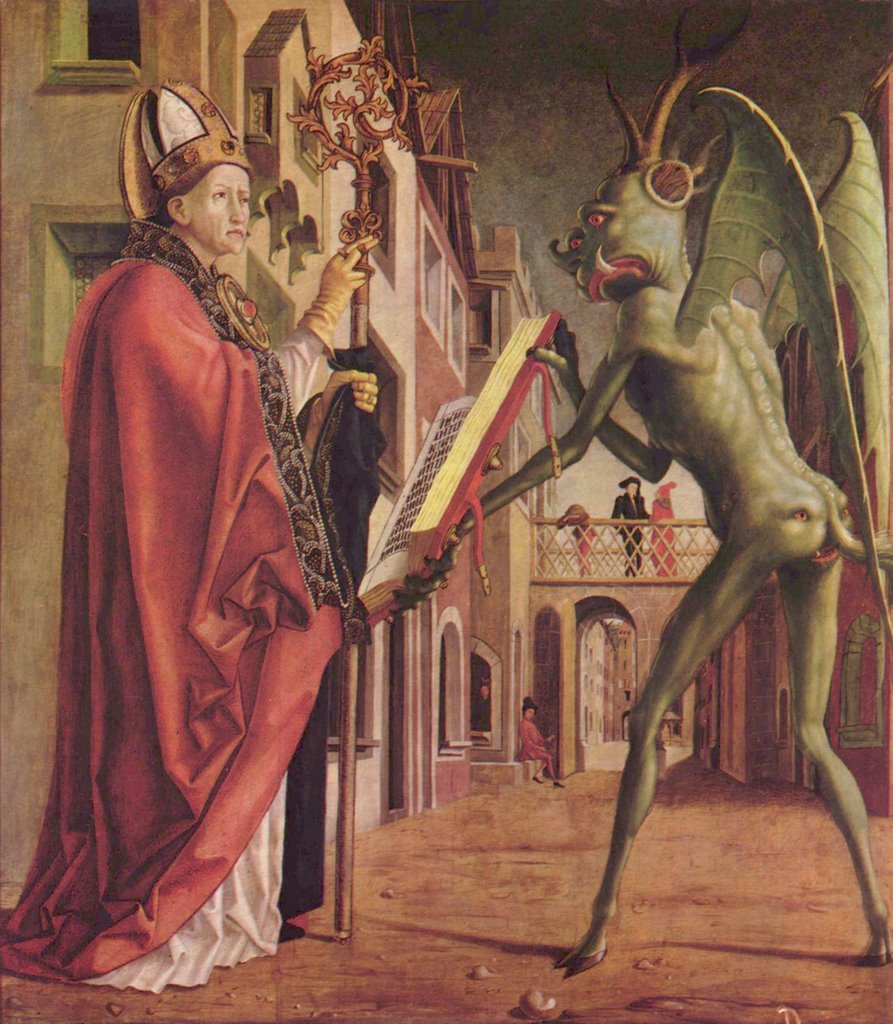
Today is the feast of St Wolfgang of Regensburg. That has little to do with what I plan to say, but the fifteenth-century painting of St Wolfgang and the devil by Michael Pacher is very cool.

I am too busy to write much and will be grumpy until election day. Just to continue with what I wrote in the last post, this "op-art" from the New York Times chronicles a number of election problems across the country. Make sure to click on the graphic. Meanwhile Hendrik Herzberg in the New Yorker, in addition to providing a scathing and correct evaluation of the Bush administration, explains some reasons why it is so difficult for massive discontent with the Republican congress to be transformed into something that is not a Republican congress.

Also, the Times reported that the interior department is not pursuing Chevron for undercharging the US government (i.e., taxpayers, i.e., us) millions for offshore natural gas production at a time in which we have troops in a war zone and the deficit is skyrocketing. You'd thing we had unscrupulous oilmen in the White House and a congress that plays dead. I wonder if we can change at least one part of that equation sometime in the next week or so.

Grump grump grump.

Friday, October 27, 2006

voting

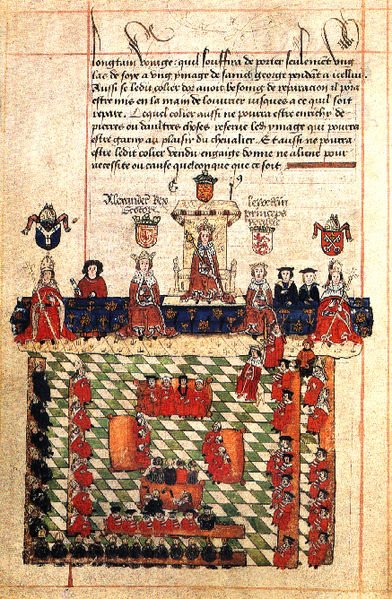
English parliament, c. 1300.

I don't have much time right now, but I'd like to throw something out for consideration. There was an article in the New York Times today about how some Democrats are concerned that African-American voters may stay away from the polls, discouraged by past problems when trying to vote.
"This notion that elections are stolen and that elections are rigged is so common in the public sphere that we’re having to go out of our way to counter them this year,” said Donna Brazile, a Democratic strategist.
The article refers to many difficulties black voters have had to deal with:

Long lines and shortages of poll workers in lower-income neighborhoods in the 2004 election and widespread reports of fliers with misinformation appearing in minority areas have also had a corrosive effect on confidence, experts say...

She [an African-American woman from Milwaukee] traced her own skepticism to one afternoon two months before the last presidential election when she overheard several young black men saying they were not going to vote because they feared being arrested at the polling station for their unpaid parking tickets. The neighborhood had been flooded with fliers from the Milwaukee Black Voters League, a fictitious group, saying that even minor infractions like parking tickets disqualified people from voting...

Mr. Walters said that episodes of voter suppression that were dismissed in 2000 as unfounded recurred in 2004 and were better documented because rights groups dispatched thousands of lawyers and poll watchers. In addition, the first national data-tracking tool, the Election Incident Reporting System, offered a national hot line that fed a database of what ended up to be 40,000 problems.

“All of a sudden after 2004, these weren’t just baseless or isolated incidents,” Mr. Walters said.

The type of misleading letter sent this month to 14,000 Hispanic immigrants in Orange County, Calif., threatening them with arrest if they tried to vote, was hardly a first. In 2004, similar fliers appeared in predominantly black neighborhoods in the Pittsburgh area, on official-looking letterheads. The fliers said that because of unusually high voter registration, Republicans were to vote on Election Day, and Democrats were to vote the next day.

Fliers sent in Lake County, Ohio, told people that if they had registered through the N.A.A.C.P., they could not vote.

What I always wonder when I hear these stories is whether and how seriously they are investigated and prosecuted. I understand there is a Justice Department investigation of the Republican candidate for congress whose campaign was responsible for the Orange County letters, but usually one hears of the complaints and not the investigations.

There are several things our country needs to do to make our system a true democracy. We need to address gerrymandering and campaign financing in a serious fashion. We also need to prosecute anyone who interferes with someone's right to vote and make them serve real jail time. Jim Crow should have died a long time ago.

Republicans are at the forefront of denying people -- mainly the poor and minorities -- their right to vote. Everything from requiring ID cards to rejecting voter registration cards because of the thickness of the paper they were printed on appears to be nothing more than an attempt to disenfranchise sectors of the population that, when the vote, vote Democratic. The standard conservative answer to these charges is that voter fraud is as big an issue as voter intimidation, and favors the Democrats. I have always believed this to be a red herring, but hey, I also agree on aggressive prosecution of voter fraud when it exists. Just don't use that as an excuse to keep people from voting.

Some countries, such as Australia, require people to vote by law. If they don't vote, they have to pay a fine. I have always found this to be a bit on the coercive side of things, but I must say it's encouraging to see that in some countries the political class is not actively trying to discourage the carrying out of the democratic process. We could learn from their attitude.

I'm not being partisan here. When they get the chance, Democrats are as happy to use funky accounting with their campgain money and to absurdly gerrymander districts as Republicans are. But who stands to win from disenfranchising the least powerful members of our society?

Tuesday, October 24, 2006

Henry IV, rock star

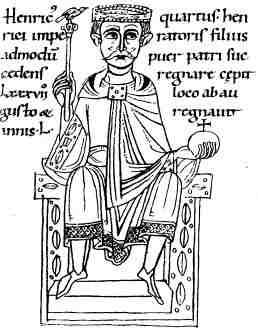
Emperor Henry IV (1050-1106)

There was a fair amount of discussion on my last post (with great contributions from Crystal, Gabriele, and Guillaume le Fou) about an accusation that Henry IV performed a black mass on his wife's unclothed body as well as whether or not one should trust Wikipedia on this issue. The Wikipedia article containing the salacious detail on Henry is here. I think Guillaume made a very good defense of Wikipedia, but I have to admit that I wish the anonymous editors would footnote their contributions, so one could get to the bottom of all this black mass stuff. The article did have listed as a source a book on Henry by a respected scholar of the period, I. S. Robinson.

Unfortunately the hard copy of the book in the Columbia library was checked out, so I had to rely on an irritating ebook version. Robinson does tell how Henry's Kievan wife Eupraxia (who took the name Adelheid upon her coronation as empress) broke with him and made common cause with the papal forces who were resisting him and his antipope Clement III. He does not mention the black mass accusation, but does say
According to the earliest account, that of Bernold’s chronicle, Eupraxia ‘complained that she had suffered so many and such unheard-of filthy acts of fornication with so many men as would cause even her enemies to excuse her flight [from her husband] and move all catholics to compassion for her great injuries’. The wrongs of Eupraxia continued to be recalled in Gregorian polemics for half a century.
So was it true? Probably not. As I said in the comments section of my last post, Henry IV was a good Christian, just one that believed the pope should have less power than the emperor. Gabriele mentioned that many of our sources are written by Henry's enemies. Robinson:
Her public statements at the synod of Constance and the council of Piacenza have never been taken seriously by modern scholarship, not because scholars could accurately judge the empress’s mentality or the emperor’s conduct, but because of their knowledge of the nature of eleventh-century propaganda. Polemicists were accustomed to ‘pay no heed to what was done or not done' but to use fictions in order to convince their audience.
The eleventh-century struggles between papal and imperial power that we call "the investiture conflict" was brutal and some of the fiercest battles were fought with letters and treatises. Robinson cites a number of letters and chronicles written by pro-papal writers, and if I look them up, I would not be surprised if I found the accusation that Crystal mentioned. In general, public denunciations were exaggerated and made particularly sordid in order to make a greater impression. Accusations such as Eupraxia-Adelheid's were sure to travel across Christendom, sapping Henry's power -- especially sapping him of the religious power that settled like an aura over liturgically anointed Christian kings and emperors.

Wikipedia's article on Eupraxia has another interesting tidbit:
According to the chroniclers, Henry became involved in the Nicolaitan sect, and hosted the sect's orgies and obscene rituals in his palaces. Eupraxia-Adelheid was forced to participate in these orgies, and on one occasion Henry allegedly offered her to his son, Conrad. Conrad refused indignantly, and then revolted against his father.
The fact that Henry might be accused of belonging to the second-century gnostic Nicolaitan sect rings true. Most certainly he didn't and there were probably no Nicolaitans around in the eleventh century, but that was par for the course in these type of polemics. You accuse your enemy of belonging to a long-vanished heresy. Such a crime would make a Christian prince no longer a Christian prince. Also, since Nicolaitans were thought to be antinomian -- that is, believers who are "beyond the law" and able to practice any kind of depravity without sin, the accusation would summon thoughts and images that would both horrify and titillate hearers. You can imagine how they would dwell on the subject.

As Crystal noted, politics have not changed that much in nine hundred years.

Thursday, October 19, 2006

politics

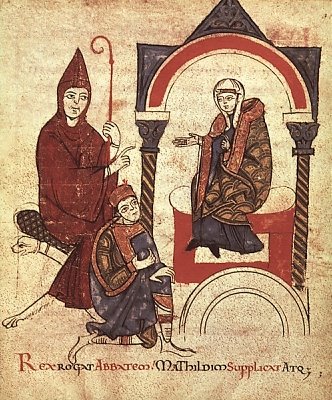
When politicians were real politicians: Emperor Henry IV begs the intercession of Countess Matilda of Tuscany and Abbot Hugh of Cluny.

I have to admit, I have become addicted to Wonkette. Funny and unapologetically catty, it is the perfect medium in which to observe the Republican political class dissolve into a trembling puddle of ineffectual hypocrisy. It is much better that dailykos or a number of other liberal (whatever that word means) blogs and websites, because although it is also obviously left-leaning, it follows the common path of the satirist and gossip: to leave no fool or hypocrite standing, regardless of affiliation. Kos and friends provide a valuable service by giving activists a common ground for uniting and bitching, and sometimes even bring important information into the political sphere. In the end, however, they are partisan in the most limited way, which is that they think political parties (in their case the Democratic party) can carry self-contained within themselves solutions to society's problems and that parties are about policies and ideologies, when really they are about naked power.

I don't mean to condemn anyone who is affiliated with the Democratic party or to say there aren't still honest idealists working within the party. Still, power is a mechanism that runs politics, and when you get together an institution whose goal is to obtain power, it's hard for it to be run for other motives. Ideology and policies are tools to achieve power, not the other way around. Even fanatical ideologues in power do not realize what really motivates them.

Corruption is not related to any ideology, it is related to unopposed power. That is really the reason people should vote Democratic next month. If the Republican party has really differentiated itself from the Democratic party, it is that all their best minds were working on politics, not policy. Their machine is well-oiled and both their base and their politicians are disciplined. Their president has received almost no opposition from congress even as his administration crafts a vision of executive power that is almost limitless. The one-party system of government, however, is beginning to show its cracks. Since a main part of their marketing was a Puritan approach to morality, the parade of scandals is especially glaring. The fact that Republicans always claim that they are the party of "personal responsibility" makes their lack of acknowledgement of their failings and their effort to throw blame in the oddest directions even more pathetic.

It will be interesting to see how much the GOP implodes. The juggling act of different forces in the party has had its tensions--how long can neo-con imperialists, plutocrats, theocratic populists, and fiscal conservatives really continue to believe they all have the same ideology? For a long time, the faithful voting patterns of the religious right has been a key, but the scandals have put their leaders into something of a quandary. James Dobson has tried to downplay the Foley scandal, but Tony Perkins (not the cool Tony Perkins) after first blaming the "culture of tolerance and diversity" (i.e., it's really the fault of people on the left), began to talk about a conspiracy of gay Republican staffers (an interesting parallel to the reaction of some conservative Catholics to the clerical pedophilia scandal -- it was not the result, they claimed, of too much power being concentrated in the hands of one group of people who protected their own, it was rather the "gay culture" encouraged in certain seminaries).

Although Mark Foley's behavior was not a result of his being gay, but of his being a creep protected by his colleagues, scapegoating homosexuals will be attractive to many on the far right -- that is, to a large portion of the Republican base. This may seal the 2008 campaign. There are two possibilities: 1) the Republicans nominate an extremist like Sam Brownback, incapable of beating whatever incompetent fool the Democrats nominate, or 2) John McCain's careful act of being a maverick (which he isn't, Bush got just about everything he wanted in his torture bill) to moderates and a conservative to the Republican base (visits to Jerry Fawell's Liberty University, etc.) will fall short of the expectations of the latter who may well support a third party candidate.

Anyway, I've gone on too long. Time to finish up so I can check the latest scandal on Wonkette.

Thursday, October 12, 2006

I'm back

A scholar presents his work to a queen, from a late medieval French manuscript.

I have returned to blogdom after a week of wrestling with a report on my research for my dissertation advisor. He wants me to start writing and of course I feel I haven't done enough research and secondary reading -- this is why if one's advisor forgets about one, one doesn't finish one's dissertation until 2047.

This is a hard endeavor. It forces me to really confront my progress and my knowledge of the material, which in the paranoid theatre of my self-esteem is always lacking. I have the little devil on my shoulder telling me that I don't know what I'm talking about, that I can't control the mass of information (well over 1,000 charters) that I am writing about, that my Latin is poor, and that what I write when I feel most inspired is nothing more than a steaming pile of merda tauri.

The oft-feared by graduate students phenomenon known as the imposter syndrome. "When," I ask myself, "will they figure out I don't know what I'm talking about?"

I will probably never get over this. It's part of how I work. Still, I wrote up some twenty pages of whatever and will now return to my routine, reading charters and cheering for the Mets. Checking Wonkette for more bitchy and amusing political gossip. Feeling sad about Iraq. Occasionally blogging. It's nice to be back.