The Man of Sorrows in the Arms of the Virgin, by Hans Memling, fifteenth century.
Yesterday I was teaching a section on women mystics of the twelfth and thirteenth centuries, and I decided to read a passage on Angela of Foligno from Caroline Walker Bynum's fascinating book Holy Feast and Holy Fast: The Religious Significance of Food to Medieval Women. It is true that I picked some particularly provocative images, but I wanted my students to get a sense of how intense and intensely physical these ideas were:
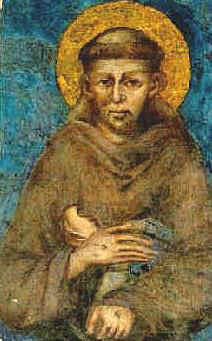
Angela repeatedly referred to Christ as "our food" and "our table," and in a vision saw him put the friars of Foligno, her "sons" into his side, whence they emerged with lips rosy from drinking blood. On another occasion Christ appeared to her all bleeding and gave his wound to suck...The students were shocked, but in the context of the class, most of them understood what I was trying to demonstrate: that these visions were a way for women, whose Eucharistic devotion was always mediated by male clergy, to experience the truths of the Eucharist in a startling literal and physical way. The physicality that we find so disturbing made sense in the context of their particular spirituality, and in the general spirituality of the time.
One student, however, was horrified and refused to see the vision as anything but pathological. She said that it was the result of women being cloistered to the point of becoming morbid, and that no woman who had lived in the world would have a vision of this type (Angela was a wife and mother before becoming a third order Franciscan, and was never cloistered). Other students argued with her that in the context of Eucharistic piety, the visions, although intense, made sense. The student, however, insisted that it was unhealthy, and eventually she extended her feelings to the general idea of the Eucharist. It was based on bloody sacrifice, she felt, and society needed to get beyond it to be healthy. The idea of eating Christ's body and drinking his blood was nothing short of vampiric, and came from ancient pagan and barbarian roots.
I hope I have presented her arguments faithfully. I don't agree with her, but I think those of us who do believe in the Eucharist should think about both Angelina's intense physical literalism and my student's reaction against it. This is especially true as Holy Week approaches and we commemorate the Passion of Christ. It is very easy to forget the import of what we are doing. God made man and tortured to death. The intermixing of God's flesh and ours through the intimate act of eating (whether you believe this is done literally or symbolically, it is still an extremely provocative idea).
Do we need sacrifice? Do we need blood? I think that it would be very naive to see this world, with all its violence and brutality, as a world that does not need to be healed. My student would say that the very idea of sacrifice perpetuates brutality. What if, however, everything could be reversed? If God, instead of demanding a lamb for bloody sacrifice, was that lamb? If God suffered in the flesh -- the warm, bloody, flesh -- what is to be suffered in this world? What does the cross mean? I think the profundity of all this demands no less than the most powerful, physical, and intimate of religious experience.
Angus Dei, qui tollis peccata mundi, miserere nobis.