Wednesday, May 31, 2006

pulp fiction

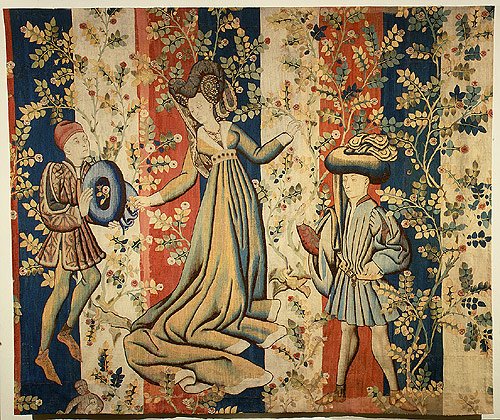
Fifteenth-century Flemish tapestry.

Via Ted at The Late Adopter, a Slate article on pulp fiction that begins by quoting a wonderful example of the genre's attention-grabbing opening sentences:
On this spot where Hollywood would one day grow, two vaqueros were crushing a priest to death with his own wine press.
—J.J. des Ormeaux, in Dime Western
I might have to hunt that story down. I have very little time for literature now, and after a day of academic articles and Latin charters, I'm really not in the mood for rereading Ulysses. I choose fun things of differing literary quality. Right now I'm reading Count Magnus and Other Ghost Stories by M. R. James (1862-1936), Cambridge medievalist and one of the masters of the ghost story genre. A wee bit back I read Matthew Lewis' magnificently over-the-top gothic novel The Monk.

In between the two I went for something sillier, The Lustful Turk, an example of nineteenth-century British "erotica." I apologize if anyone is shocked by my indulgence of Victorian porn, but I have always found it terribly amusing. The variety of euphemism is wonderful, and the weird mix of sex and proper old-fashioned English prose is hilarious. It's sort of like getting Queen Elizabeth II drunk on tequila and asking her what the Duke of Edinburgh is like in the sack. It is also fascinating just as social artifact: what can you learn about a society from its porn? I don't want to do this for our own society, it's too depressing, but nineteenth-century England is another question.

The Lustful Turk lives up to these expectations, and yet is mercifully short, since it relies on repetition of the same story as a plot point. It follows the capture by pirates of the young, beautiful, and virginal Emily Barlow who is presented to the Dey of Algiers and promptly initiated against her will into the pleasures of the flesh. At first horrified, she soon becomes an enthusiastic participant. Then she meets two of the Dey's other wives, and we hear the same story of conquest repeated with little variation.

Even though I was not taking the book seriously, I found the repeated emphasis on rape disturbing. Culturally, I should have expected it -- the male "other" is often represented sexually as both aggressively threatening and exaggeratedly potent. The African-American man is portrayed this way in our society and so was the Jew in medieval society. Since it was a Victorian treatment of "the east," I took my copy of Edward Said's Orientalism off the shelf. Said refers only briefly to The Lustful Book, but he led me to a 1964 book that has more to say about it: The Other Victorians: A Study of Sexuality and Pornography in Mid-Nineteenth-Century England by Steven Marcus. Marcus remarks that our book is one of the first of a long line of books in the genre. He focuses on the story's phallo-centrism and how it relates to literature. Although his discussion is fascinating, he does not mention what seemed obvious to me when reading the book: the relationship of rape and conquest to imperialism.

The Lustful Turk was first published, it appears, in 1826, just a quarter way into the great century of European colonial expansion. Marcus, discussing the historical development of pornography (although he concentrates on more domestic aspects of sexuality), says:
Although the impulses and fantasies with which pornography deals are trans-historical, pornography itself is a historical phenomenon. It has its origins in the seventeenth century, may be said to come into full meaningful existence in the latter part of the eighteenth century, develops and flourishes throughout the nineteenth century, and continues on in our own [p 282].
That is, it follows the same path as European (and later American) imperialism. There are many interpretations that could be drawn from this observation, but I will limit mine to what I felt as I read The Lustful Turk: the fantasy of domination extends to both sexual and political spheres. The Dey is terrifying and violent, but in the end he is right. He has to take what he wants by force, but as the violator and the violated settle into the situation, the violated realizes that what seems like brutal and unfeeling exploitation by the violator is actually a gift and to the benefit of both parties. Domination by violence seems brutal, but in reality it brings peace through the gifts the dominator can only give by imposition: sexual pleasure, civilization, democracy...

Of course there is an odd tension throughout the book: the violated women are European and the rapist is the ultimate "other," an Oriental, a Turk. Marcus warns us against using literary analysis too much in studying pornography: pornography and literature serve different purposes. The anonymous author of The Lustful Turk is out for thrills, not consistency. The fact that Emily is English allows the male reader to read her thoughts expressed in his language and idiom. It also may provide the misogynistic thrill of seeing the domination of a woman of his own society, the nearest "other" to him. It permits the projection of one's own aggression onto the orientalized Turk, and the exotic location in which there is complete domination of women (the harem) is probably another thrill for the Victorian man. Still, the tension causes the author to flip the situation on its head in the bizarre ending of the novel: the Turk attempts to rape a Greek girl who defends herself by castrating him. He allows Emily not only to return to England, but to take with her the severed member preserved in a jar! The author has it both ways: domination of women and castration of the threatening other.

I propose we think about fantasies of domination and forced gifts of pleasure. Perhaps after all, The Lustful Turk is not, as I had thought, light reading.

PS: Please read the post below about the internet if you have not yet done so -- it's important.

Tuesday, May 30, 2006

save the internet

Medieval internet users.

Sunday's New York Times included an editorial that correctly identified a danger to "net neutrality" from telecommunications companies that are aggressively lobbying for the ability to charge sites for access to customers. This means companies like Verizon or AT&T could control the speed at which certain sites load, and even cut access to a given site.

"Net neutrality" means that it is as easy to access Ford Motor Company's site as it is to access a site criticizing Ford. It is as easy to watch YouTube as it is to watch CNN. The tremendous possibilities that the internet offers culturally, intellectually and politically exist because of this thoroughly democratic ability to access any information someone is willing to put on a webpage. A battle is going on in congress right now that could put an end to these possibilities.

Please act. To sign a petition as well as to learn more about the issue, go to Save the Internet.com (I especially recommend the video "Ask a Ninja About Net Neutrality" for an entertaining take on the issue). Save the Internet.com is a coalition of individuals and groups concerned with the issue, remarkable diverse group (it includes MoveOn.org, The Christian Coalition, Gun Owners of America, and US Pirg, to give you an idea of how the support of Net Neutrality reaches across the political spectrum). Their f. a q. page is a good place to start for understanding the issue.

Keep the internet what it is, for at least a little while longer.

Thursday, May 25, 2006

this and that

Rockers of the fourteenth Century.

A few posts ago, I wrote a post called Things I don't believe in any longer, and I complained about the Democratic Party. I was going to write at least one other installment about Rock & Roll. I still listen to quite a bit of it, depending on how you define it (I really don't care what section the cd is in the store -- there's a place by my apartment where they break music into two categories: 'independent" and "establishment (released before 1990)." Oh, so The Residents are establishment and Britney Spears is independent, you smirking young mamones? -- anyway, I'm getting off the subject). Still, I don't see it, as a style of music, as really being more liberating or anti-authoritarian than any other. When I was an angry teenager growing up in the Reagan years, it seemed different. I bought my electric guitar and listened to the Who, and it seemed that the music had some kind of redemptive force. As Lou Reed sang, it could change your life:

Jenny said, when she was just five years old
You know there's nothing happening at all
Every time she put on the radio
There was nothing going down at all
Not at all

One fine morning, she puts on a New York station
And she couldn't believe what she heard at all
She started dancing to that fine-fine-fine-fine music
Ooohhh, her life was saved by rock n' roll
Hey baby, rock n' roll

Despite all the amputation
You could dance to a rock n' roll station
And it was all right
It was all right

Of course, Lou was singing partly tongue in cheek and partly recognizing the force popular music has had on youth since long before rock was invented: the liberation for the hormone-crazed, angry and confused that comes from dancing to that fine fine music. There's nothing really political about it. But forty years of pretentious rock critics and the marketing of a faux-rebellious attitude has made rock & roll what my friend Guillaume le Fou refers to as "one of the great all-time liberal myths." It is nothing more than a consumer product that allows people to pretend they are more rebellious than they actually are. Once again, I am not talking about any given song or performer, but rather about a concept: rebellious, anti-authoritarian rock & roll.

I say this as a prelude to an article about some very silly people that was in the Times today. A silly writer for the National Review put together a "top 50" list of songs he considers "conservative." Here's the article and here's the list. This is what John J. Miller, the silly writer, has to say about the project:

"Any claim that rock is fundamentally revolutionary is just kind of silly," he said. "It's so mainstream that it puts them" — liberals — "in the position of saying that at no time has there ever been a rock song that expressed a sentiment that conservatives can appreciate. And that's just silly. In fact here are 50 of them."

The Times of course got a counter-opinion from a silly liberal:
Asked to comment on the list, Dave Marsh, the longtime rock critic and avowed lefty, saw it as a desperate effort by the right to co-opt popular culture. "What happened was, my side won the culture war, in the sense that rock and related music is the dominant musical form, not only in the U.S. but around the world," he said. "Once you lose that battle, you lose the war, and then a different kind of battle begins: the battle over meaning."
They are both silly because both of them miss the point. Rock is conservative, not because of any of the lyrics are or are not conservative, but because it is a perfectly marketed item that makes rich people richer, repeats the same forms it's been using for fifty years, often harkens back to a golden age of simpler and purer rock, and confirms rather than challenges simple senses of identity. I mean, really. I see 17-year-punks with mohawks, safety-pin jewelry, and tight red plaid pants. That's 1977 -- I'm too young to have worn that style in its heyday, and I'm turning 40 in two months.

Miller's lists of songs do contain some songs whose lyrics would probably not offend and might well please the most rancid reactionaries on the far-right wing of the Republican Party. Other choices show a certain amount of fantasy on his part. Some show the weird sense of definition of political stance that some conservatives have, for example, "Revolution," by the Beatles. Since John Lennon sings "But if you go carrying pictures of Chairman Mao, you ain't going to make it with anyone anyhow," Miller identifies it as conservative. Right, I guess liberal = Maoist. "Why didn't you vote for John Kerry?" "I was afraid of the Cultural Revolution."

One of his picks that annoyed me personally was the following:

6. "Gloria," by U2.
Just because a rock song is about faith doesn't mean that it's conservative. But what about a rock song that's about faith and whose chorus is in Latin? That's beautifully reactionary: "Gloria / In te domine / Gloria / Exultate."
Excuse me, dude, but I love Latin. Look at the title of my blog. I have a secret to tell you: I can be a person of faith who loves Latin and my politics are way, way to the left. Amabo te, tace stulte Miller. Potesne etiam hoc legere? Linguam et liturgiam latinam diligo, sed rationem tuam et partidem Rei Publicani parvi aestimo.

Enough of this -- I have to get to work.

Sunday, May 21, 2006

gloria cibi africae occidentalis

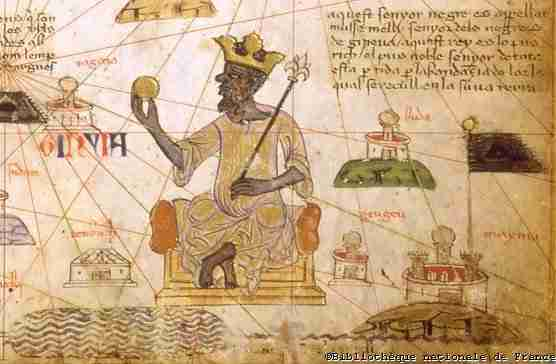
Mansa Musa, the "Lion of Mali." A great ruler of the 14th-century Empire of Mali.

This is a blog post that I have been planning for some time. In fact, I have been photographing meals for the past month and a half or so, and now I know that if the PhD does not work out, I have a backup profession: food stylist.

My dearest, imperatrix pulcherrima Africae occidentalis, is one of the Mandingo people of West Africa. Her family is from Liberia, but its origins are in Mali and perhaps she is a descendent of Mansa Musa. She has so many good qualities I have no hope of listing them all, but the one I would like to honor today is that she has introduced me to the food of her country, which she makes exquisitely.

West African cooking has a great deal of variety, but the basic premise is this: throw all the animals you can find into a pot with some water and very hot pepper. Stew it. That's about it. If you are a vegetarian who doesn't like spicy food, sorry. There's not much you can do. I will now describe three of the dishes, but I can't give you any specific recipes. It doesn't work that way. You throw things into a pot, that's about it.

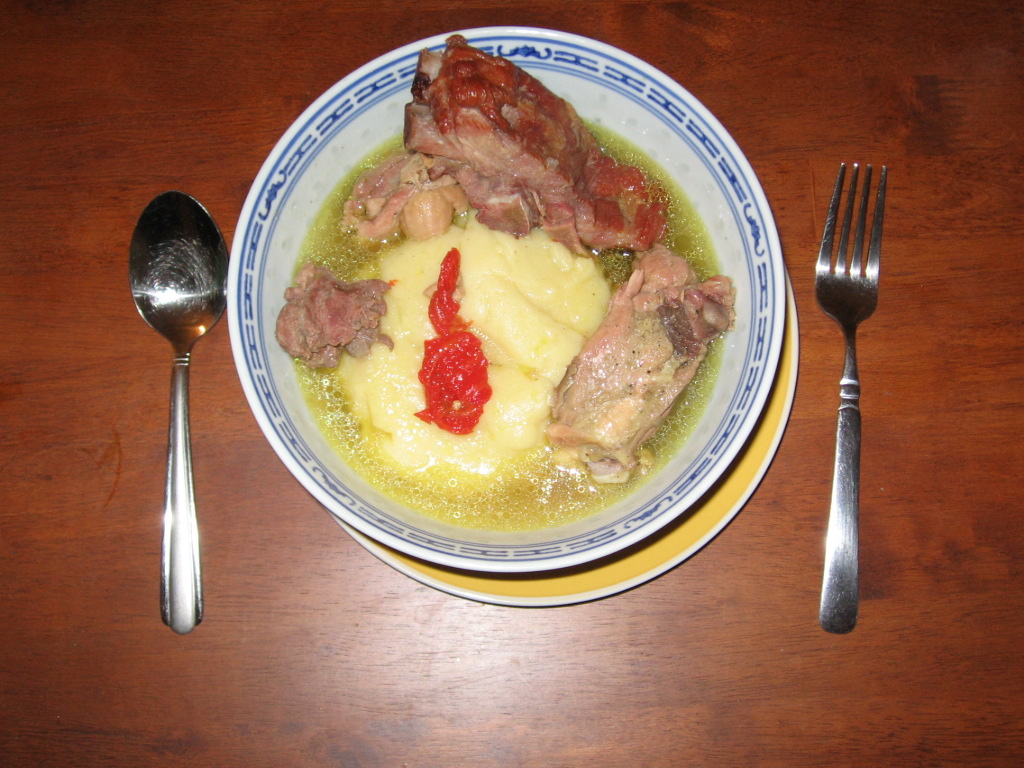
Pepper Soup with Fufu

This is the purest expression of the "throw it all in the pot" approach to gastronomy. In this case, we have chicken parts, stew beef, smoked turkey, and pork or lamb, I can't remember. Anything that walks, flies, swims or crawls can be added. Imperatrix pulcherrima Africae occidentalis will use shrimp when she makes it for others, but I'm allergic, so... You season the meat with salt, pepper, and bullion. Brown it in oil with chopped onion and hot pepper, then add water with bullion and stew it.

This is served with fufu: a majestic doughy ball of starch. Fufu flour is made with cassava or yams or plantains, etc. You mix it with water, form a big ball, and pour the stew over it. Filling and delicious, it is a meal that asserts itself with authority and dedication. Imperatrix pulcherrima Africae occidentalis often makes it for us when we are sick, since it combines the healing properties of chicken soup with the skin pore-opening and nasal passage-clearing effect of hot pepper.

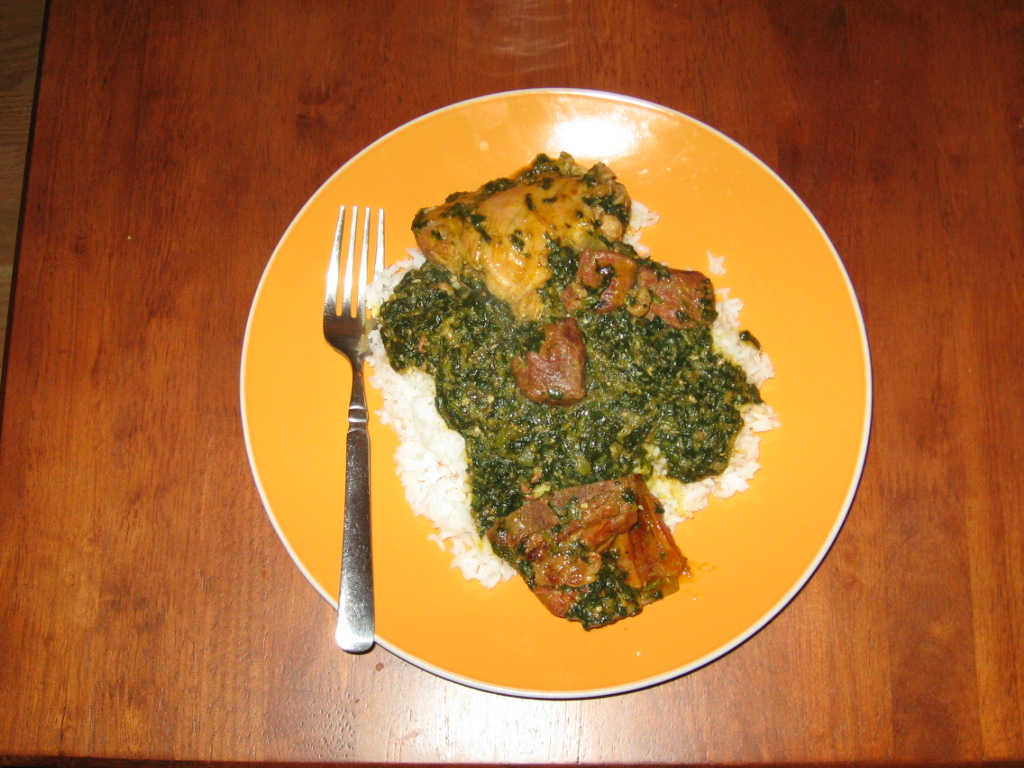
Spinach and Rice

I have made pepper soup before, but now we are moving onto things I have only eaten, so my knowledge of the cooking process is a bit more shaky. As you can tell from the variety of meat here, once again we are following a "kill them all" approach to the barnyard. This dish is prepared in a similar fashion to pepper soup, only with less water and the addition of chopped spinach and palm oil at the end. It is served on top of a healthy serving of white rice. Pepper soup can also be served with rice instead of fufu; chez nous we serve it in another bowl on the side. You need some kind of starch because it is very spicy.


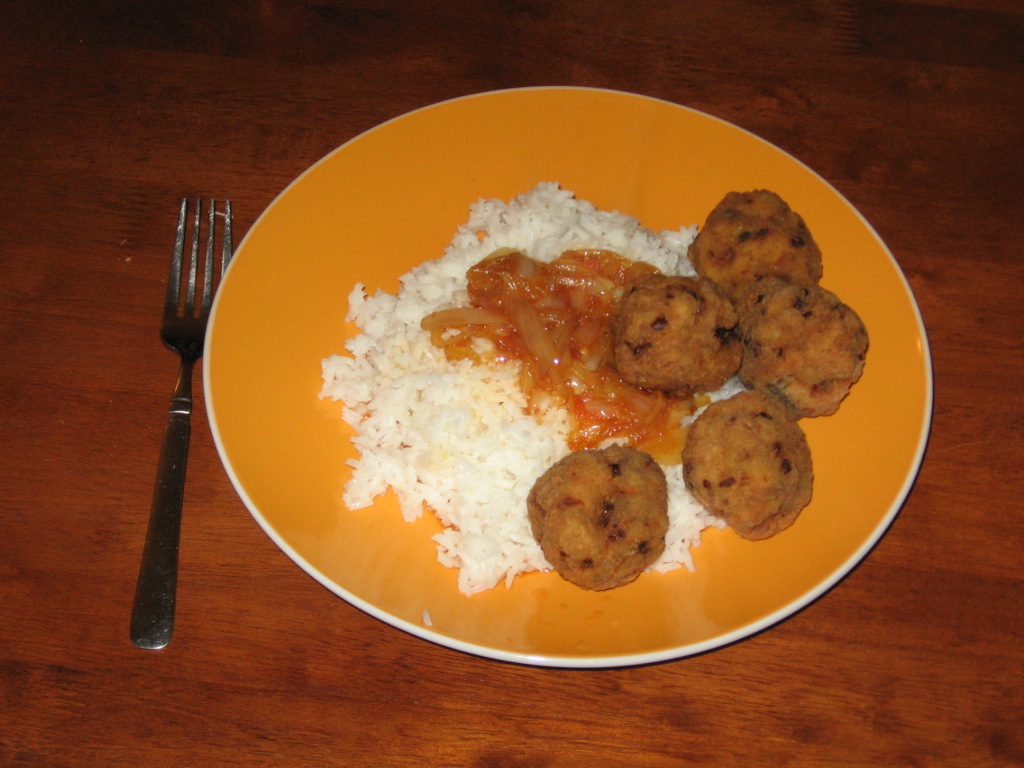
Fishballs!

This made Lenten Fridays much less penitential. I was not allowed to follow the making of the secret fishballs, but I know it involved bluefish, kingfish, chopped onions and peppers, flour and very hot oil. The sauce you see has something to do with tomatoes and onions. As I said, it was a secret. The fishballs were gloriously spicy and flavorful.

I'm not a great fan of fish usually, but imperatrix pulcherrima Africae occidentalis has a gift with seafood. She also makes a non-African fish stew that I can't get enough of.


Ingredients

The peppers are essential. We get what are called here in New York "Jamaican peppers," available in supermarkets in neighborhoods with a sizeable Latino population. Accept no substitutes. These peppers have a superb flavor and have powerful spice magic. One or two is enough to make a pot of pepper soup that can make a whole family sweat.

I buy fufu flour at a store in "Little Senegal" on 116th Street, but it can be found in surprising places (imperatrix pulcherrima Africae occidentalis actually found it in a store in Salt Lake City). Google it and you can probably find it online. The same goes for palm oil, thick, red, oily and flavorful.

Everything else is pretty standard.

I have to admit there are parts of West African cuisine that I'm not so crazy about. Imagine a nuclear warhead detonates over a lake. You walk the dry lakebed and find the radioactive remains of the fish that once swam peacefully in its now-vaporized waters. You can find this fish in African stores. I refer to it as "post-apocalyptic death fish." It has a strong flavor, and I really don't like it.


Post-apocalyptic Death Fish

(I should say that imperatrix pulcherrima Africae occidentalis does not agree at all with my characterization of the aforementioned Death Fish. She insists that I explain that it is actually smoked with herbs and peppers, and tastes "wonderfully delicious." She says one should think of it as fish jerky. I will let the reader decide.)

Friday, May 19, 2006

slow day

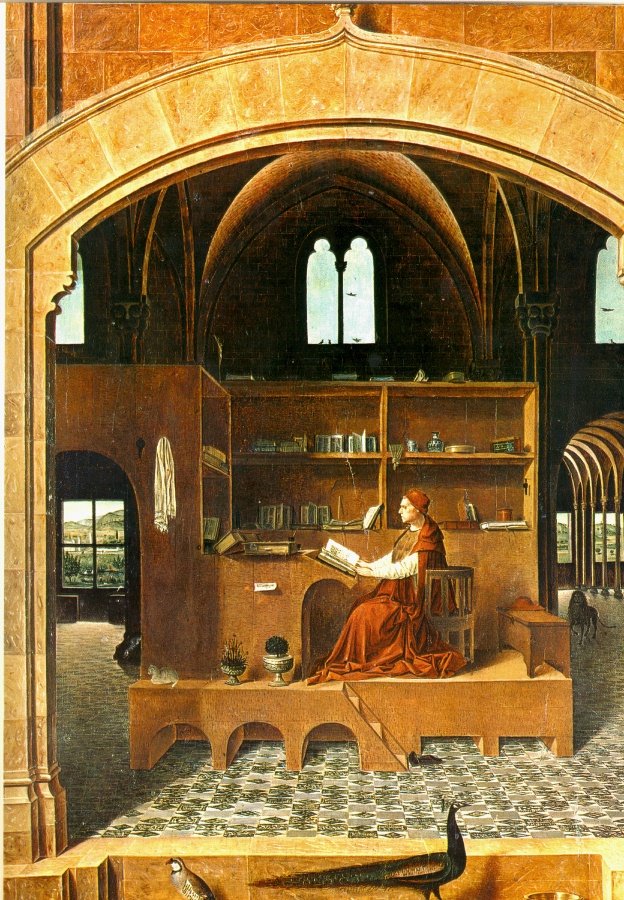
St Jerome, hanging out. Note lion to the right of him.

The hardest thing about dissertation land is its complete lack of structure. I've been trying to dive into work after finishing teaching and things have not gone so well. I have dipped into some charters and read a couple of articles, but that's about it (one account of a trial did contain an oath that was interesting because of the religious language in it). So... Monday. I promise. If any of my blogging friends find me leaving long comments on their blogs Monday morning, say to me, "Very interesting, Liam... NOW GET TO WORK."

I plan to rest this weekend. Last weekend was the First Communion of Filius imperatricis pulcherrima Africae occidentalis with party afterwards, both of which were great, but I could have rested more. The Mass was at ten o'clock on Saturday, and I awoke to find I had no more coffee in the house (serious concern). I found myself in the horrible situation of being at a Starbuck's at 8:00 AM Saturday morning surrounded by peppy people in jogging attire, all of this at a time at which all good Christian women and men should be at home sleeping off their gin. Not good.

A couple of things to comment on: The Catholic blogosphere is buzzing about the Vatican's restriction of the ministry of the 86-year old founder of the Legionaries of Christ, Father Marcial Marciel Degollado (whose second last name means in Spanish, curiously enough, "one whose throat has been cut"). Marciel has been accused of several cases of sexual abuse and although he has not been removed from the priesthood, he can no longer preside at public masses or give conferences. There will be no formal canonical procedure against the founder of the conservative organization due to his advanced age, but according to the National Catholic Reporter, "In effect, Vatican sources told NCR this week, the action amounts to a finding that at least some of the accusations against the charismatic 86-year-old Mexican priest are well-founded."

There is more than one way to look at this. Marciel was held in great esteem by the late Pope John Paul II, who praised him publicly, so this could mean that the Church actually is getting serious about the issue and that even high-ranking and influential churchmen are not free from facing the consequences of their reprehensible actions. On the other hand, the fact that their will be no canonical procedure could mean that there is no formal condemnation and the Church is once again responding to sexual abuse by evasive tactics more concerned with image than justice. I myself have not decided what to think of the whole thing, but I have heard these different evaluations of the situation.

***

Yesterday I actually left the neighborhood and went to go see a movie: The Proposition, with a screenplay by Nick Cave. It was a brutal Australian Western: imagine Sam Peckinpah meets Joseph Conrad. The New York Times has a good review of it. Then I went to my favorite restaurant in New York, Fried Dumpling, which stands nobly between Chinatown and the Lower East Side, and offers five tasty dumplings for a dollar. Lovely.

Now, I would like to write something completely absurd:
The young Lady Flatterswhip grew bored of her surroundings. Bored of the Sussex estate, bored of the visits from the vicar, bored of the rose garden and tea parties, bored of the longshoremen and zebras that mysteriously congregated around the front drive of the manor on alternate Tuesdays. She even longed on occasions for what now seemed like the happy bygone days of the Mongolian prison. Dreading the oncoming storm of social obligations as croquet season approached, the only relief for her came from a letter in the hand of her brother Denby in South America, which brought with it the shocking news that...

Monday, May 15, 2006

da vinci, etc

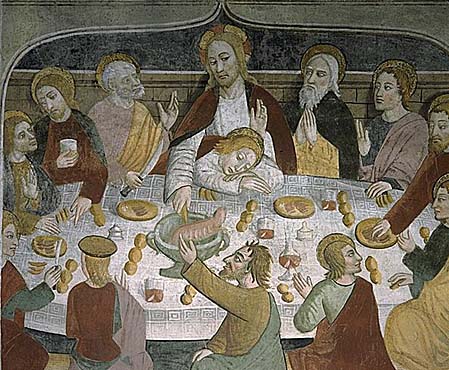
Look! Who is that right in front of Jesus with soft features and no beard? It must be... Mary Magdalene, the secret wife of Christ whose descendents are the true Holy Grail and whose story has been ruthlessly suppressed by the evil Catholic Church! Jeepers! It's a good thing that Leonardo was a member of the secret Priory of Sion and knew the truth, and could transmit it through a code... Wait... That's not Leonardo's Last Supper, it's a medieval wall painting from the south of France. Oh... So the apostle John was always represented that way? Oh...

I swear, I don't know why The Da Vinci Code gets my goat so much. I mean, I read the damn thing and even enjoyed it after I got over the vapid prose, wild historical errors, and cardboard characters. I'll probably see the movie if I get the chance. Still, when I hear mention of it on a blog (like Steve's or Crystal's), I go on and on about it. Why is that? It's not so much a question of blasphemy or offence to my religion (although it really is insulting to Catholics), rather I think it's offensive to my calling as a historian. Look, we historians work very hard. We read lots and lots of documents, some of them very old and written in dead languages with very difficult scripts, and we are methodologically almost pathologically anal. We realize that history is complex and never easy to explain. The real causes of events are myriad and intangible, the evidence is often spotty and the questions usually outweigh the answers. When we teach history, we want to give our students a coherent story of what happened in the past, fighting in a Sisyphean manner against an accepted narrative based on pop-culture simplifications and vulgar prejudices. The last thing we need is a testacazzo like Dan Brown making things harder for us.

Oh, please do not tell me "it's just a novel." Yes, but Brown places a page at the beginning claiming that certain of the things referred to are "facts." These "facts" include the existence of both the ancient "Priory of Sion" (invented in the 1950's by a fanatical French anti-Semite) and the documents about the "priory" in the French National Library (forged and planted there by the aforesaid anti-Semite). This sets the tone for many discursive passages in the book in which characters explain even more "facts" about early Christianity, the Church, art history, etc. Brown makes it obvious that he wants the reader to see his information as based on a real, credible alternative reading of history. Spike Lee's "Do the Right Thing" is "just a movie," but I'm sure Lee would be upset if we were not to take seriously the many brilliant insights about race and American society he transmits through the film's fictional story. Both works claim a certain seriousness, even if Lee's film is good movie-making and profound social commentary whereas Brown's book, although admittedly a page-turner, is from the literary and historical point of view a pure exemplar of birdie doo-doo.

Perhaps the Catholic in me is slightly annoyed as well. I mean, there is so much to criticize in the Church, why come up to me and spout this drivel in order to get me to change my beliefs? A couple of Christian commentators, being wise and generous, have pointed out that the fact that people get excited by conspiracy theories of this type or look to the gnostic gospels as evidence of some kind of cover-up of "true Christianity" may be due to the fact that what they see as Christianity is disappointing. Perhaps. But it takes very little investigating to see how clearly they are barking up a wrong tree (to see some responsible debunking of the Da Vinci claims, here are two alternatives from the official Catholic and secular perspectives). Maybe my annoyance is primarily that of an academic. Why even try if people will not check with the experts to see if a particular theory holds water? Once again, the triumph of anti-intellectualism. Why read a book on early Christianity by a respected scholar when you can read the Da Vinci Code? Why listen to every responsible scientist in the country about global warming when you can just invite a guy who writes thrillers about dinosaurs to the White House to help formulate your policy?

I'm beginning to get whiney, I'm sorry. I'll shut up now.

One more thing: a moment of silence for one of our oldest poets, Stanley Kunitz who died this weekend at age 100. Flights of angels, Stanley.

PS: Speaking of loss and scholars, one of the great historians of Christianity, Jaroslav Pelikan, died this weekend at age 82. Requiescat in pace.

Friday, May 12, 2006

outrage, french roves, and the australian gothic

The panther, from the Aberdeen bestiary. Why? Because it's cool.

I have turned in the finals I was grading. No more school, no more books, no more students' dirty looks. Next year I have funding without teaching and I can spend all my time dissertating. Ole.

Filius imperatricis pulcherrimae Africae occidentalis is celebrating his First Communion tomorrow and I have to go downtown and get a bow for his arm (odd). First, a couple of information tidbits:

The United States, though the wealthiest country in the world, is at the bottom of the list of industrialized nations for infant mortality. This is obscene. Why is there not an outcry? Where are the family values here? Where are all the patriots? I demand anyone who claims to be patriotic to stop worrying about flags and which language the national anthem is sung in and to do something to make this a major issue. Would it not show greater love for our country to be concerned about the health of our infants? For God's sake, children are dying when they don't have to.

For those of you out there who believe there is no longer racism in our country, African-American babies are twice as likely to die as white babies.

Enough of my soapbox (the title of my blog does mean "opinions and shouts"). Other subjects: I don't believe in reincarnation, but some things make me wonder. Karl Rove, for example, appears to reoccur throughout history. At the beginning of the fourteenth century he was an advisor of the King Philip IV "the Fair" of France under the name of Guillaume de Nogaret. Nogaret was a specialist at inventing charges to attack the King's enemies. He was instrumental in Philip's purely mercenary suppression of the Knights Templar, and left his mark in the trumped-up charges against them (sodomy, witchcraft). He accused Pope Boniface VIII of keeping a mistress in order to cover-up his homosexuality. He was also a master of the vindictive political gesture -- after Boniface had died, he wanted to dig up the pope's body and put it on trial for heresy (something that actually had happened in the tenth-century trial of the dead pope Formosus at the famous cadaver synod). Hmmm... Perhaps it does take more than one life to make a Rove.

Last thing: For a long time now I have been a great fan of the Australian singer Nick Cave. His music is dark and powerful, his lyrics gothicly exaggerated but evocative and intelligent. Again and again he returns to religious themes (for example, his eerie portrayal of John the Baptist in the song Mercy or his spare portrait of the twelfth-century mystic Christina the Astonishing). He also sings about sex and violence, so I was never quite sure how much his interest in religion was purely aesthetic. The other day, however, I found something he wrote on the Gospel of Mark, and it seems he is, in his own way, a believer. Oh, the many ways to approach the Gospel.

Monday, May 08, 2006

no one has to read this

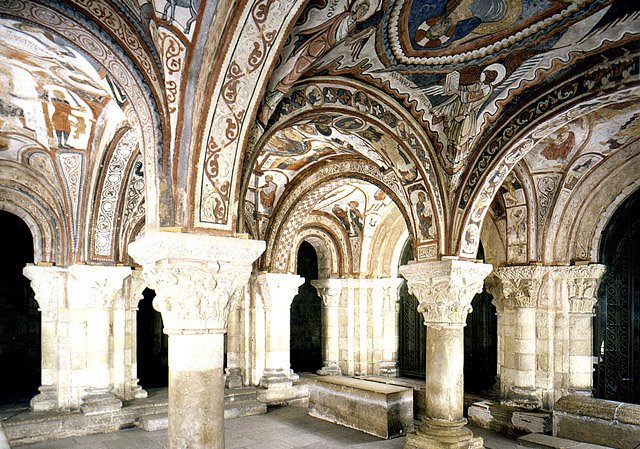
The crypt of San Isidoro, burial place of Leonese kings.

The semester is winding down. When I finish grading finals this week, it's over and I can concentrate on the dissertation. I have decided to paste the introduction of my dissertation prospectus below, withour footnotes, in case anyone wants to see what I will be doing for the next couple of years.

The Use of Religious Language in the Construction of Royal Power: León-Castile, 1037-1157

One of the major pillars of growing monarchical power in eleventh- and twelfth-century Western Europe was religion. The king’s relationship with the institutional powers of the church both inside and outside his realm (i.e., the bishops, abbeys, religious orders and the papacy) was occasionally contentious, but it often served to cement the king’s authority, an authority which was never unquestionably secure against the nobility and other claimants to the throne. In addition to this negotiated political and institutional support upon which the king could rely, there was also a less tangible but perhaps more potent factor that he could summon to his aid: the sacral nature of kingship itself. The king, as king, was holy. Kings came and went, and this sacrality was never a guarantee that a king’s authority, or even necessarily his person, would be respected. Still, that sacrality could provide at times the king’s strongest source of support for his claims of prerogative (as it was for the eleventh-century French Capetian kings, for example). Sacral power is intangible, but important, and underpinnings of royal power cannot be grasped unless we can find some way to show how it functioned, who fashioned it, and what possibilities it provided monarchs who were trying to cement their authority.

The eleventh- and early twelfth-century was a period of great expansion and definition of royal power. In France, Capetian monarchs were beginning to assert themselves against the superior power of their nominal vassals, the counts and dukes that surrounded their reduced area of influence in the Isle-de-France region around Paris. England and Sicily saw the advent of powerful and centralized Norman monarchies. Meanwhile, in the north-western regions of what is now Spain, Christian rulers took advantage of infighting among the Muslim leaders of the mini-states that had replaced the once-hegemonic Caliphate of Cordoba at the beginning of the eleventh century. Rulers of the Christian kingdom of León-Castile, having enriched themselves with tributes from Muslim rulers, went on the offensive, and expanded their territory twofold by 1150. At the same time, the division of royal patrimonies among surviving princes, intrigue, and warfare among the Christians themselves created a shifting political situation: León, Castile, Portugal, Navarre, Aragon, and Galicia were all independent kingdoms at one time or another over this century and a half. Institutions were rudimentary and authority was uncertain; at the same time León-Castile enjoyed the reigns of some very accomplished monarchs. This makes the study of the Leonese monarchs of this period very useful for understanding the cementing of monarchical authority that was taking place throughout Europe. The political and institutional elements of Leonese kingship have been the target of excellent scholarship, but their use of religious language and their sacrality is still terra incognita, and study of those subjects will shed light on the religious nature of kingship beyond the borders of León-Castile.

The sacral nature of kingship takes many forms and is expressed or indicated in a variety of ways. Charlemagne’s advisors referred to him as a new David, providing an intellectual model of an Old Testament kingship that was divinely ordained. Other forms of giving religious force to rulership were liturgical and performative, and perhaps the most striking was the anointing of kings during a coronation ceremony. The Capetian kings of France practiced this with great effect and were anointed with a sacred oil kept at Rheims and which according to legend had been brought down from heaven by angels on the occasion of the crowning of Clovis, the fifth-century founder of the Merovingian dynasty. This conveyed great symbolic force, reserving for the king a act that was at least quasi-sacramental and possibly fully sacramental, for at this time the nature and number of the sacraments was not yet definitely set by the Church, and some theologians included the anointing of a king in their lists of sacraments. Anointing also directly connected the body of the king with the sacred, in a public ceremony performed in a liturgical setting.

Although we know the Visigothic kings who ruled Spain before the Muslim invasion of 711 were anointed, the evidence about the kings of León-Castile is inconclusive. Even if the kings were not anointed, an examination of the sources we have leaves no doubt about the connection of Leonese kings with religion in one capacity or another. A study of these texts may reveal different and hitherto uninvestigated modes of sacrality that explain how religious kingship functioned both in León and in the rest of Western Europe.

The most direct surviving sources for the Leonese kings are royal charters written for them, usually in connection with a donation to a religious institution. These charters often feature elaborate religious language, invoking the Trinity, dedicating the donation to the patron saints of the institution, or discussing the religious duties and aims of the monarch. They are signed not only by the king, but by important bishops, abbots, and magnates of the realm. This suggests a public occasion featuring the reading and signing of the document in which the person of the king would become associated with the religious ideas expressed.

The fact that the charters were written in Latin need not mean that they would be unintelligible to those present who were not clerics. The distinct separation between “learned Latin” and “vulgar Romance” in this period has been questioned and there is no reason to suppose that those present would not understand language they had already heard on various other occasions. Also, and perhaps more importantly for the evaluation of the effect this language had on the listeners, the charters were filled with the same biblical quotations and references that their hearers knew from the liturgy, and the liturgy – the Mass and other sacred celebrations – was the major point of contact of the medieval believer with the Bible and other religious texts. Elaborated over centuries, it allowed for a complex act of worship that was codified and set to reflect the passage of the year, marking major feasts as high points and also commemorating the great wealth of saints to which the medieval church paid homage. Studious monks who spent a great deal of time copying or reading books of scripture, exegesis, and theology spent even more time in the opus Dei – the “work of God,” that is, the liturgy of hours that convoked monks for prayer seven times a day. Since religious texts—especially the Bible—were experienced primarily in the liturgy, that means they were experienced primarily orally and communally.

If it is given that both charters and biblical language were not experienced by those around the king only—or even primarily—as texts, but rather as oral, public, and liturgical acts, we can then investigate how the religious language that was used effectively conveyed sacrality to the monarch. The charters, when read in public, might have created a liturgical event that associated the king with prayer. Studying their language from this perspective, we can begin to see exactly how this process worked, and what associations were created for the monarch – what aspects of religion were chosen to be in some way transferred to the king. This way a more precise idea of how religious kingship functioned in this period may emerge. This model of sacrality need not be a construction made purely by the monarch, or purely as part of a conscious and well-thought-out program. Documents not prepared by the king’s notaries themselves and even forgeries give us an idea of what religious associations were credible in this context for this period. They show what possibilities of religious power existed for the king to tap into and what possibilities made sense for the other power players in the king’s realm.

Examined together with religious language from other sources, such as chronicles, and examples of patronage of religious art, these charters allow us to see how a particular image of sacrality that was transferred to the king as religious power became a source of political power. More subtle than constructed ideology (referring to Charlemagne as David) or unequivocal ceremony (anointing), this use of language might reveal the more intangible aspects of medieval religious kingship. By studying a dynamic monarchy in one of the most rapidly changes areas of eleventh- and twelfth-century Europe, we have a unique chance to understand the powerful nexus between religious and political power—a nexus as vital today as ever.

Monday, May 01, 2006

yo era inmigrante ilegal

Medieval pilgrims. Were they there legally?

I was an illegal immigrant. I don't say this in a vague sense of solidarity, as in "we are all (insert name of persecuted person here)." For the first two or three years that I lived in Spain, until I got official residency, I was there illegally. Unlike for Africans, Arabs, or South Americans, this wasn't much of a problem for me, and I can't say that I know what the millions of undocumented, frightened, and exploited immigrants in our country are going through. Still, it makes me bristle when I hear people who support cruel draconian measures justify their inhumanity by saying, "Well, they broke the law coming here. We can't reward them for that."

(Of course I know that not one of those who say that ever cheated so slightly on their taxes, took a hit off a joint, or even went 50 miles an hour in a 45-mile-an-hour zone. No, because any breaking of any law is unpardonable, even for someone who has been working in this country for twenty years. I know that each and every one of those indignant immigrant-haters have not so much spit on the ground, because if so, what would be their justification? Maybe... racism? Hmmm...)

I broke the law in Spain. Of course, in a Mediterranean country, "breaking the law" is seen quite differently than here, but still... Am I ashamed? No. It was 1989. Spain was undergoing a burst of prosperity after joining democratic Europe and there was a desperate need for native-speaking English teachers. No one cared. The economy needed people like me.

Right now, in the United States, we have millions of hard-working, family-oriented people who love this country, and have not been able to regularize their status. The system is broken. No one obeys laws that don't make sense.

Look at it this way: imagine that in order to feed your family, you have to work downtown. The only way to get there is to drive. Your employer wants you there. There are many parking spots, but every last meter is broken. According to a city ordinance, you cannot park in a space with a broken meter. There are no other spaces, and everyone is parking next to a broken meter. Enforcement is spotty, almost non-existent. There is nothing you would love more than to pay your quarter and go to work, but your only option is to break the law.

The system is broken.

Most immigrants would love to come legally if it were an option. They obey the laws once they're here.

It is not always immoral to break a law. Sometimes it is immoral not to break the law.

Rose Parks broke the law.

The system is broken.


PS: I wrote this last night, and thinking of it this morning, it may seem that I accuse anyone who is concerned about the effects of immigration of harboring racist sentiments. I do not. When I refer to "draconian" measures against immigrants, I mean the current plan offered by the House of Representatives, that would give undocumented immigrants felony status and criminalize anyone who aids them -- according to the Catholic bishops, this could be anyone who gives someone food or medicine without asking for their papers first. I realize that someone may disagree with about the economic effects of the level of immigration we have now without xenophobia playing a part. What I was really thinking about are people like this guy:
"When the rule of law is dictated by a mob of illegal aliens taking to the streets, especially under a foreign flag, then that means the nation is not governed by a rule of law — it is a mobocracy," Jim Gilchrist, a founder of the Minutemen Project, a volunteer group that patrols the United States-Mexico border, said in an interview.
This concern about law is from a leader of a vigilante group.

The fact that so much stink can be raised about what language the national anthem is sung in (that grown-ups are even discussing this shows that demagoguery is being employed here in full force) is evidence of an uneasiness about cultural issues. A lot of what is said about this new cultural element in society was said about my Irish ancestors and the ancestors of most non-WASP people just a hundred years ago. People should be honest about their motives.

Friday, April 28, 2006

misinterpreting the middle ages yet again

I have instructed Yahoo to send me an email whenever it comes across an article that contains the words "medieval" [because that's what I study], "professor," [because that usually means there is an academic voice commenting on whatever the issue at hand is], and "king," [because I study kinship]. More often than not, the stories they send me are extremely arbitrary, but sometimes I find something fun, and on rare occasions, I find something useful.

Today I got this story from the BBC. It is about something someone told me in high school: that the musical interval known as the tritone (e.g., the diminshed fifth or augmented fourth) was thought to be "Satanic" in the "Middle Ages," and was "banned" by "the Church" (quotation marks provided not by the pimply and naive electric guitar-playing adolescent Liam from 1983, but the graying medievalist Liam from 2006 -- the guitar is under the bed, I will take it out some time). This is an article from the BBC, no less, and it is illustrative of what the professor for whom I am a TA right now calls the power of the narrative about the Middle Ages. As I grade papers right now, I see that despite our efforts throughout the semester, some students still seem under the spell of the received narrative they brought with them to the class: the Middle Ages were a time of ignorance and superstition in which a single, monolithic "Church" crushed free thought until we were saved by the Renaissance and the Reformation. It's a simple, clear, and thoroughly wrong idea of what happened.

This article is a case in point. I can imagine its genesis: a reporter decides to cover a story that seems amusing enough: heavy metal musicians are attracted to a musical interval that was "banned" in the Middle Ages. How curious! How exciting! We can all imagine the scene. Some poor minstrel has a bit too much spiced wine and strums the wrong chord on his lute. He is immediately captured by grim monks, their faces shrouded in heavy cowls, and, after a few days on the rack, a few nights hanging on the wall of a dungeon, he is handed over to the inquisition and is immediately burned at the stake.

This must have happened all the time. In the Middle Ages. Surely.

The author of the article has authorities to back up the narrative. Professor John Deathridge of King's College London says:
There are strict musical rules. You aren't allowed to use this particular dissonance. It simply won't work technically, you are taught not to write that interval. But you can read into that a theological ban in the guise of a technical ban.
Yes, you could read something into it if you wish. If, like Prof. Deathridge, you are a Wagner scholar opining on something completely out of his subject area. Still, what he says here at the beginning is probably much closer to what might have happened: there were musical rules and this interval didn't work technically. The same way you can't use Schoenberg's twelve-tone technique when writing a country song. Medieval music was written according to a particular framework and had a great deal of music theory around it from the start. This could well be more like a ban of using oysters in chocolate cake than a ban of Harry Potter at a fundamentalist Christian school.

Closer to the end of the article, we have the view of another scholar, Anthony Pryer, whose opinion is even more disappointing for the received narrative:
It was recognised to be a problem in music right back to the 9th Century. It is a natural consequence, and so they banned it. They had rules for getting around it. It was called Diabolus in Musica by two or three writers in the medieval or renaissance [period]. It was 'false music', the intervals weren't natural. They may have thought it was devilishly hard to teach the singers not to sing it. I don't think they ever thought of it as the Devil dwelling in music.
So the association with Devil appears only briefly in the voluminous writing on music theory in this period, and the meaning of it is not clear. I'm not even sure what he means by "they banned it." Did that mean that music teachers taught that it was not to be used? Was it banned for use in sacred music because it sounded bad (they way that many Catholics now would like to see a ban on certain kinds of music used in the liturgy)? If it was a ban pronounced by the institutional Church, was it done by a bishop? Two bishops? A legate, a pope, a council? Was it enforced? Was it known about outside a small area? To say something was "banned" in the Middle Ages is meaningless without further context.

We have to remember that the Church in the Middle Ages was not like the Catholic Church now. There was an effort from the papacy, starting in the eleventh century, to centralize and homogenize liturgy, belief, and ecclesiastical structure. There were, however, too many competing forces for that to work and the papacy lacked the technology to control the whole of Christendom they way they would have liked to. Conservative groups within the Church often tried to ban activities within the same Church that they saw as dangerous, but more often than not these bans would be local and they were also usually ignored (like the ban of teaching Aristotle a the University of Paris).

I have to admit that, like Prof. Deathridge (what a wonderful name for an English Wagnerian), I am speaking outside of my field, since I am not a musicologist. I have not researched this particular issue. But hey, this is just a blog. I may ask the medievalist in the Columbia music department next time I see her. Still, I have seen this kind of misinterpretation again and again, and it smells fishy.

The narrative, however, is powerful. So our journalist starts out his article with a quote that does not come from either scholar, but from "rock producer Bob Erzin":
It apparently was the sound used to call up the beast. There is something very sexual about the tritone. In the Middle Ages when people were ignorant and scared, when they heard something like that and felt that reaction in their body they thought 'uh oh, here come the Devil'.
Thanks, Bob. In the Middle Ages. When people were ignorant.

Thursday, April 27, 2006

Hurrah!


My dissertation topic, "The Use of Religious Language in the Construction of Royal Power: Leon-Castile, 1037-1157" has been approved by my committee.

Let me at them charters!

Monday, April 24, 2006

sspi

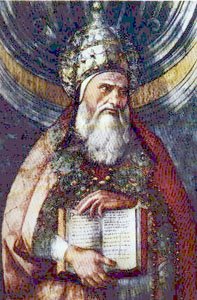
Pius I, pope 142-155.

A friend of mine emailed me the following diatribe. Apparently it was from a website making fun of the more extreme Catholic traditionalists. The site no longer exists, so I decided to reproduce it here. It's very funny. They get the tone and the reasoning down, from the USE OF CAPITALS to the accusations of Freemasonry. It also cleverly points out the dangers of obsessively reductive traditionalism.

Before the fun starts, I want to state that I have no bone to pick with less extreme traditionalists as long as they have no bone to pick with me. I think the Latin liturgy is beautiful and have no problem with the Latin Mass being available as long as it is not the only alternative. I myself prefer a Mass that is lively and partcipatory but also solemn and aware of tradition. Some Latin is always nice. For more discussions on liturgy, I recommend the blog Catholic Sensibility, which features thoughtful posts on the liturgy and varied but respectful comments from those who agree and disagree with the posts.

Here's the fun:

The Society of St. Pius I

"To be any more Trad, you'd have to be Jewish"

Welcome to the fledgling website of the Society of St. Pius I (SSPI). Unlike other so-called "traditionalist" Roman Catholic groups, we adhere to the ORIGINAL Roman Catholic Mass of A.D. 40-200, and described by St. Justin Martyr and the Apostolic Constitutions, and used by Pope St. Pius I of happy memory.

Don't be fooled by PHONY "Vulgate" neotraditionalists, who claim to protect tradition, and yet still defend the RADICAL and totally UNCATHOLIC reforms of the 4th century A.D. So-called "trads" pretend to be against the modernism of the last hundred years, but where were they when the original Rite of Rome, the Greek rite USED BY ST. PETER AND THE APOSTLES was being totally gutted and revised by unknown scholars and translated into the vernacular language of Latin?

Unlike other wimpy neotraditionalist groups who attach themselves to various other Piuses, we at the SSPI make absolutely ZERO compromises with modernism. We reject not just one, but BOTH "Novus Ordos"-the Novus Ordo of 1970 promulgated by Paul VI, and the Latin Vulgate Mass of 400 A.D. promulgated by Innocent I and Pope Gregory I, which we call the "Vulgar Mass."

Thanks to the miracle of the internet, we can now spread the TRUTH about the REAL Roman liturgical tradition which is being kept alive only by a brave remnant of faithful Catholics: myself and whoever else wants to join.

--Klaudios Philadelphou, Archon and Caesaropapist of the SSPI

"We're not approved...and we don't want to be"

Facts everyone NEEDS to know about the "Traditional" Latin Mass

FACT: Even the neotrad "Catholic Encyclopedia" admits the Latin Mass was a radical break with tradition! The REAL Traditional Roman Mass is the Greek Mass of the first three centuries as described by the Apostolic Constitutions
and the Apology of St. Justin Martyr. The "Catholic Encyclopedia" written and published in 1913 by diehard "pre-Vatican II" neotrads, was forced to admit that its oh-so-precious "Latin Mass" was a radical and unprecedented break from tradition unlike any that had ever gone before.

Just read these shocking quotes from the article "Liturgy of the Mass":

"The origin of the Roman Mass, on the other hand, is a most difficult question. We have here two fixed and certain data: the Liturgy in Greek described by St. Justin Martyr (d. c. 165), which is that of the Church of Rome in the second century, and, at the other end of the development, the Liturgy of the first Roman Sacramentaries in Latin, in about the sixth century. The two are very different."

"He [Justin Martyr] describes how the Holy Eucharist was celebrated in Rome in the middle of the second century...we have hardly any knowledge at all of what developments the Roman Rite went through during the third and fourth centuries...By the fifth century, we come back to comparatively firm ground, after a radical change."

"But between this original Roman Rite (which we can study only in the Apost. Const.) and the Mass as it emerges in the first sacramentaries (sixth to seventh century) there is a great change."

"This brings us back to a most difficult question: Why and when was the Roman Liturgy changed from what we see in Justin Martyr to that of Gregory I? The change is radical, especially as regards the most important element of the Mass, the Canon."

"At Rome the Eucharistic prayer was fundamentally changed and recast at some uncertain period between the fourth and the sixth and seventh centuries. During the same time the prayers of the faithful before Offertory disappeared, the kiss of peace was transferred to after the Consecration, and the Epiklesis was omitted or mutilated into our ‘Supplices’ prayer.”

Finally, the article quotes the liturgical historian Rauschen as saying:

"We must then admit that between the years 400 and 500 a great transformation was made in the Roman Canon."

What more proof could anyone POSSIBLY need?! The so-called “Traditional Latin Mass" is NOT traditional at all!!! It's a drastic change in 200 years of liturgical tradition, and one concocted by unknown scholars and unaccountable liturgical "experts." It is a dangerous modern innovation that is putting millions of souls in jeopardy!!


FACT: Latin is NOT the original language of the Church!

It's a VERNACULAR language that was foisted on the Roman church by Pope Victor I (A.D. 190-202), who was an AFRICAN priest--NOT a Roman!!! The earliest liturgies at Rome as described by St. Justin Martyr were in GREEK. But once Victor made the change in language, that OPENED THE DOOR a century later to a barrage of changes in the rite of Mass itself, from which the Roman Rite has NEVER recovered.

This opening up of vernacular languages has led to the Church becoming a veritable Tower of Babel, full of all sorts of barbarian languages that were NOT SPOKEN BY THE APOSTLES. Was this what Christ intended when he prayed that the church be one? A hodgepodge of incomprehensible barbarian tongues that were formerly used to worship fake gods like Jupiter?


Die-hard Vulgate Pope John VIII even allowed Cyril and Methodius to translate the liturgy for the Slavs into Old Church Slavonic!!

Wouldn't you want to use a language that was actually spoken by the Apostles, rather than some barbarian language spoken by goatskin wearing savages? EVERY SINGLE BOOK of the New Testament was written in GREEK. Not Latin. Not Syriac. Not Coptic. Not Old Church Slavonic. And especially not English. This fact alone PROVES that these other languages are inventions of SATAN and CONDEMNED BY GOD.

So whatever later so-called "Popes" may have said about the use of Latin, it IS NOT TRADITIONAL!!!

And even further, linguists have shown that Nero--who is identified by some biblical scholars as the archetype of Antichrist in Revelation--spoke Latin. Do you really think God would want you to be using the Antichrist's language--IN A CHURCH?????


FACT: The traditional Roman Mass was celebrated in catacombs, NOT churches!!!

Above ground churches are a LATE development in the Roman church which date to the legalization of Christianity by Constantine. They were NEVER part of the original Roman rite!

So what was so wrong with the church going above ground? Above ground is where PAGAN temples were built. And in order to appease and "get along with" their new false-god worshiping neighbors, modernist Romans started to build unholy ecumenical shrines that confirmed and incorporated their wrong and idolatrous ideas. Don't just take my word for it--just ask a Jehovah's Witness--even they'll tell you it's true!!!

The Pantheon for instance, was a PAGAN Roman temple which was reconsecrated as a church by Pope Boniface in A.D. 609!! Pagan building, Catholic building--what's the difference, right?? Then in the reign of Pope Zacharias (741-752) another church was built on the ruins of a pagan temple and called "Santa Maria sopra Minerva". Minerva was a Roman goddess—many Catholics DIED HORRIBLE DEATHS rather than offer a tiny pinch of incense to her. And yet their supposedly Christian descendants NAMED a church after her!!! Even the ecumaniacs at Assisi never did anything like this--put a false goddess' name ON PAR with the Virgin Mary, Mother of God!!!!

In accord with holy tradition therefore, we must reject any and all above-ground church structures, in accordance with the true traditional practice of the Roman church. Unfortunately, funding issues and zoning laws in our locality have so far prevented us from excavating new catacombs in our area, so we are temporarily headquartered behind the water heater in our basement.

FACT: Pope Gregory the "Great" was a liturgical "reformer"

Neotrads love to say their Mass goes back to Pope Gregory I in the 6th century. But how much do they REALLY know about this ultraliberal legislator who helped solidify the final destruction of the TRUE traditional Roman Rite?

Even a pope firmly entrenched in the Vulgar Mass, Benedict XIV said that "no pope has added to, or changed the Canon since St. Gregory." He thus ADMITS that St. Gregory changed the Canon!!!

Gregory's biographer John the Deacon tells us that Gregory "collected the Sacramentary of Gelasius in one book, leaving out much, changing little, adding something for the exposition of the Gospels."

Gregory also moved the Our Father from the end of the Mass to the Canon. He also added the phrase "Diesque nostros" to the Hanc Igitur prayer. This is the prayer that says "Graciously accept, then, we beseech You, O Lord, this service of our worship and that of all Your household"--it asks God to accept ALL forms of worship!!! Incredibly, Gregory did NOT change this part of the prayer despite its obviously heretical approval of false worship!!!

To make matters worse, in a letter published in Bede's Ecclesiastical History of the English Nation, Pope Gregory approved a totally untraditional ecumenical "concoction" for use in Britain: "Your brotherhood knoweth the custom of the Church of Rome...But it pleaseth me, if you have found anything, be it in the Church of Rome, or France or any other...zealously choose and spread in the Church of the English...the things that you have been able to gather from many Churches." So instead of demanding that Augustine use the traditional Greek Mass to England, Gregory just had him cobble together an "ecumenical" liturgy from every country and "zealously" spread it. Neotrads complain to no end about Cranmer's Protestant Mass in England, but Gregory started the trend a thousand years before!!! Cranmer just finished the job!!

We also have a reliable source from Italy who informs us that a recently excavated mosaic clearly depicts Pope Gregory kissing Vergil's Aeneid!!!

But to answer the question on everyone's mind, was Pope Gregory a Freemason?


Despite apparently accurate claims that the organization did not even exist back then, the Freemasons THEMSELVES claim otherwise, and say that they date back to Ancient Egypt. It is therefore POSSIBLE that a fifth century pope may have joined the organization. Significantly, our top researchers at the Society have NOT been able to DISPROVE Gregory's membership in the Masons, and, most importantly, NEITHER HAS ANYONE ELSE. Prudence therefore DEMANDS that we treat all of his liturgical "reforms" as HIGHLY suspect and potentially heretical.

Pope Gregory was the "Great" all right--the great changer of the Canon and the great ecumaniac to boot!!

Fact: the people behind the "Latin Mass" promoted Dialogue with FALSE RELIGIONS!!!

Neotrad "Saint" Jerome, who imposed his Vulgate Bible on the Latin world, took instruction in Hebrew and Talmud from Jewish scholars, and even followed their opinions (e.g. in his Commentary on Joel iv. 11). Says the Jewish Encyclopedia: "Although other Church Fathers quote Jewish traditions none equal Jerome in the number and faithfulness of their quotations". He was being "faithful" to Judaism's traditions, while at the same time ruining Catholic traditions by translating the Bible into the evil language of Nero!

Most shockingly of all, Jerome also wrote a book called "Dialogue with the Luciferians
" --LUCIFER????? Is there NO ONE these neotrads won't DIALOGUE with????!!!! At what point do we just say--NO... WE DON'T DIALOGUE WITH LUCIFERIANS??!!!

By the way, some snide sarcastic modernist type pointed out that our hero St. Justin Martyr also wrote a "Dialogue with Trypho the Jew
." Yeah, we knew that. So what?


FACT: St. Paul said to "hold fast to the traditions you have been taught"

Ask yourself--are today's Novus Ordo neocons and Latin Mass neotrads REALLY holding fast to TRUE ROMAN tradition?
DID they hold fast to the Greek liturgy that St. Peter and Paul brought to Rome? Or are they just too happily clueless in their little Gallicanized-Roman Rite and its "ecumenical" combination of Latin and Frankish??


ANNOUNCEMENT: Real Traditionalist Priests wanted!!

No priest has of yet had the courage to join our brave and heroic movement. So we are currently looking for Greek-speaking priests who may have said the liturgy of St. Justin Martyr in their youth. Candidates must be able to prove Apostolic Succession directly from Popes Peter, Linus, Cletus or Clement.

NOTE: Greek Catholic/ Greek Orthodox Rite priests NEED NOT APPLY!!!
We have arbitrarily decided not to like you guys either.
Saturday, April 22, 2006

things I don't believe in any longer

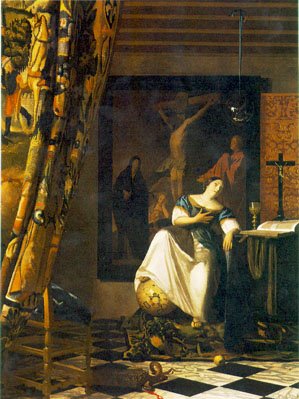
Vermeer's Allegory of Faith. I still have faith in many things, but there are at least a couple of ideals that have lost their shimmer of meaning for me. For example:

1. The Democratic Party. Perhaps it's the party, and not I, that has lost its faith. I still believe in the things the Democrats say they believe in: equality, social justice, compassion. Yes, I will still vote Democrat when it matters, that is, when my vote counts -- if, for example, I am still living in New York in 2008, I don't know if I will vote for the Democratic candidate. I won't vote Republican, but if the party decides on somebody like Hillary Clinton, I just might have to write in the late Paul Wellstone. If I'm living in someplace like Ohio or Florida, I would probably vote for Hillary and then stay drunk for two weeks.

It does matter -- the 2000 election shows that yes, there can be a great difference between Republicans and Democrats. I even gave money to the Democrats in 2004. Still, I am tired of getting emails and letters from party leaders telling me how we all know how bad the Republicans are and how I have to send them money to fight their evil ways. This is the message they send the true believers on the left. Their attitude in congress and in the media is completely different. It doesn't matter how bad the war gets, how many laws the president violates, how shamelessly corrupt their corporate-friendly laws and no-bid contracts are. The Democrats offer the least of resistance.

Of course, in many ways their hands are tied by their own cowardice and lack of political will and imagination. Most of them voted for Bush's war and Patriot Act. Terrified of appearing weak, they showed themselves to be unfathomably spineless. With Bush's approval rating at 33%, much of which has to do with the war, they still can not put together a collective alternative, despite individual efforts like that of John Murtha, who was slandered by the Republicans amid the general complacency of his fellow Democrats. When Russ Feingold suggested censoring the president for breaking the law, his colleagues avoided him like the plague. One can argue about whether that proposal was appropriate or not at this time (I believe it was), but it was the kind of proposal that I would expect from the party that sends me those letters asking for money to fight the Republicans.

Please Nancy, Howard, John, and Hillary, (to quote Bob Dylan): "Don't send me no more letters, no." Not unless you grow some cojones and actually act like an opposition with vision.

Stop letting the Republicans define the terms of the debate. Whenever Democrats protest the reasons for the war, the GOP shouts back, "you had the same information we had." Please. The information came from the administration. The Democrats should say, "If we supported the war, it was because we were mislead by the information provided by the administration. We were at best given bad information by incompetents, at worst fooled by liars. Either way, the administration is guilty of leading us into a war for the wrong reasons."

Will they ever say something like this? Call the GOP on the war, the corrupt and incompetent reconstruction afterwards, the pushing of laws dictated by the oil or the pharmaceutical industries, the obscene racism and social injustice built into our system and made evident during the tragedy of Hurricane Katrina?

I recall Nanni Moretti in his film Aprile, watching a televised debate between his preferred candidate, Massimo D'Alema, and the horrible Silvio Berlusconi. Berlusconi talks on and on and D'Alemo can't get a word in edgewise. Moretti, frustrated, begins to shout at the TV screen:

"D'Alemo, say something left-wing!

Say something sensible even if it isn't left-wing!

Say something!

React!"


That's what I want to shout at the Democratic Party, and if they follow my advice, they might actually win control of congress in November and the presidency in 2008. Then I might start to believe a little, though at this point I don't promise to do anything but vote for them in extreme situations. Listen, Democratic Party:

REACT!


This post is getting long. I will discuss other things I no longer believe in later.

Wednesday, April 19, 2006

warm weather and the end of the semester

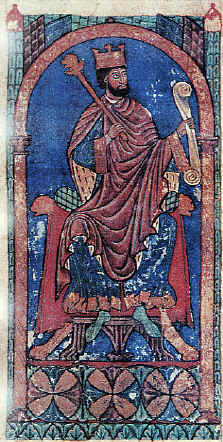
Alfonso VII -- I will have to be getting back to him.

After a Holy Week of intense blogging, I have picked up the work I have to do and am bracing myself for the end of the semester. Filius imperatricis pulcherrimae Africae occidentalis has the week off from school and it's supposed to get near 77 degrees tomorrow, so I plan to take him to Central Park tomorrow, even though I will be dragging books with me.

A few things:

-I distributed my dissertation prospectus a week and a half ago and will be defending it on the 27th. Wish me luck.

-The students in the class I am a TA for hand in their papers on Monday. Again, wish me luck.

-William Sloan Coffin, RIP.

-I downloaded the entire Latin Vulgate Bible onto my PDA. Sometimes I love the 21st century. The Vulgate and other versions of the Bible are available here.

Time to take out summer clothes and prepare for the warm weather. Summertime -- the living is easy. Fish are jumping and the cotton is high. Your daddy is rich and your momma's good-looking. So hush now, little baby, don't you cry.

Saturday, April 15, 2006

Via Crucis Grid Blog: Stations XIII & XIV

The Via Crucis Grid Blog concludes.


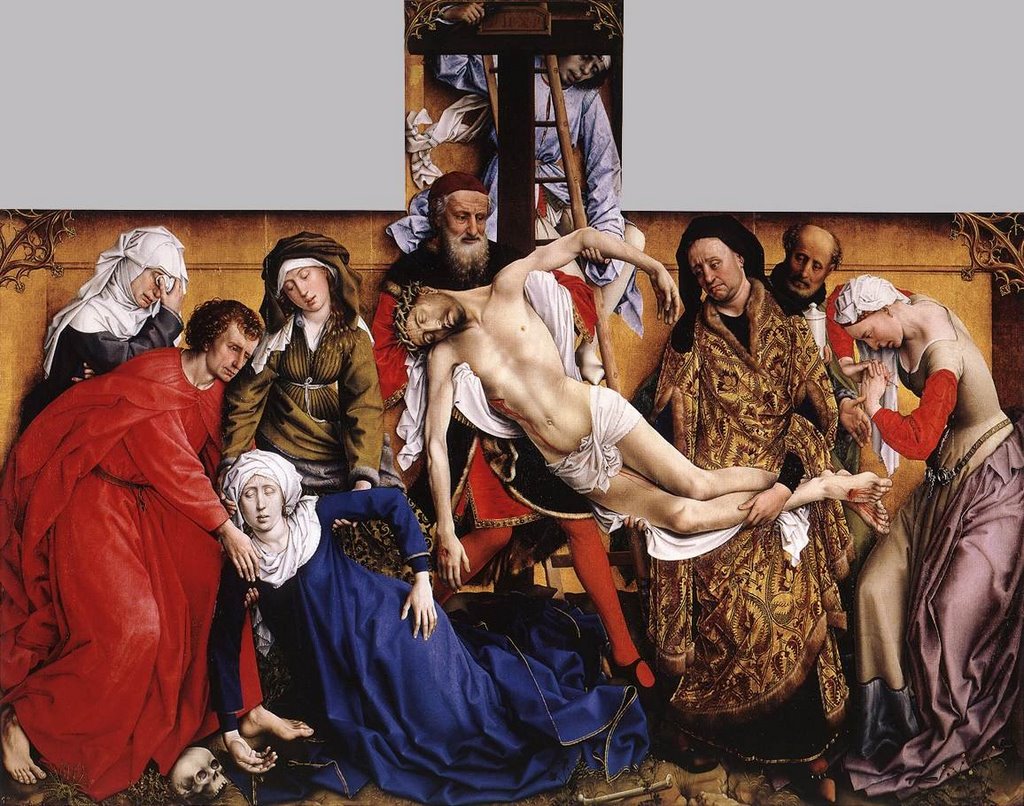
Station XIII: Jesus' Body is Taken Down from the Cross

There were also women looking on from a distance. Among them were Mary Magdalene, Mary the mother of the younger James and of Joses, and Salome. These women had followed him when he was in Galilee and ministered to him. There were also many other women who had come up with him to Jerusalem. When it was already evening, since it was the day of preparation, the day before the sabbath, Joseph of Arimathea, a distinguished member of the council, who was himself awaiting the kingdom of God, came and courageously went to Pilate and asked for the body of Jesus. Pilate was amazed that he was already dead. He summoned the centurion and asked him if Jesus had already died. And when he learned of it from the centurion, he gave the body to Joseph. Mark 15: 40-45

At the cross, there are no apostles (except, in John, "the disciple whom he loved), just at a distance the women who had followed Christ from Galilee. When he is taken down from the cross, they perform the task that has been performed by women across the centuries -- washing and perfuming the body of the dead, the body broken by senseless violence.

Mary, the mother of Jesus, is not mentioned in the gospel accounts of this moment. But John has her at the foot of the cross as Christ dies, and artists have sensibly placed her in the scene, either swooning or cradling her dead son in her arms. She is the Mater Dolorosa, our Lady of Sorrows, experiencing as a mother the sufferings of the world through her son.

How many mothers are cradling their sons in their arms now, their bodies pierced with bullets or knives, broken by sticks or rods, disfigured by torture? How many women stand at a distance and watch cruelty unfold as it has for centuries? Mater Dolorosa, ora pro nobis.

Christe, cum sit hinc exire,
da per Matrem me venire
ad palmam victoriae
.

Daily Via Crucis bloggers: Renee, Mike, Argent, Best & Worst, Shawn, Joseph, Kat, Rick, Stephanie, Karen
Station XIII bloggers: Mike, PmPilgrim, Tom


Station XIV: Jesus' Body is Laid in the Tomb

Taking the body, Joseph wrapped it in clean linen and laid it in his new tomb that he had hewn in the rock. Then he rolled a huge stone across the entrance to the tomb and departed. But Mary Magdalene and the other Mary remained sitting there, facing the tomb. Matthew 27:59-61

This is the end of the Via Crucis and one might think it is the end of the story. A man preaches and performs miracles, and in the end is too threatening to the authorities, so he is killed. He is placed in a tomb and the tomb is closed. He and his teachings will be remembered.

The Via Crucis is about suffering and sorrow, and how Jesus, by enduring suffering and sorrow in his own person, shared the sufferings and sorrows of the world and thus redeemed them. For even if we are mocked, tortured and made to die a horrible death, Christ is there with us and we experience nothing that he has not felt himself in his own flesh. To meditate only on the part of the Gospel that speaks of suffering is not correct, but to ignore it is to lose a profound part of the message, as well as to refuse to see the suffering around us.

Still, the story is not over. The women left at the tomb would return. Where there had been darkness, night, and sorrow, there was light and joy. The tomb was empty and guarded by an angel. Sorrow and suffering, even death, have been triumphed over. It Easter, the day of Resurrection.


Quando corpus morietur,
fac, ut animae donetur
paradisi gloria. Amen
.

Daily Via Crucis bloggers: Renee, Mike, Argent, Best & Worst, Shawn, Joseph, Kat, Rick, Stephanie, Karen
Station XIV bloggers: Mike, Jimmy, Tom

Friday, April 14, 2006

Via Crucis Grid Blog: Stations XI & XII

The Via Crucis Grid Blog continues.


Station X: Jesus is Crucified

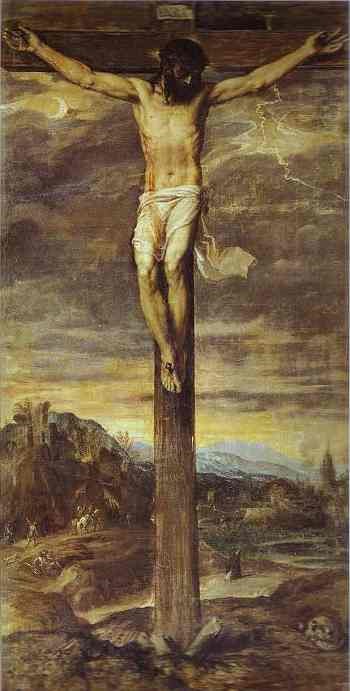
When they came to the place called the Skull, they crucified him and the criminals there, one on his right, the other on his left. Then Jesus said, "Father, forgive them, they know not what they do." They divided his garments by casting lots. The people stood by and watched; the rulers, meanwhile, sneered at him and said, "He saved others, let him save himself if he is the chosen one, the Messiah of God." Even the soldiers jeered at him. As they approached to offer him wine they called out, "If you are King of the Jews, save yourself." Above him there was an inscription that read, "This is the King of the Jews." Now one of the criminals hanging there reviled Jesus, saying, "Are you not the Messiah? Save yourself and us." The other, however, rebuking him, said in reply, "Have you no fear of God, for you are subject to the same condemnation? And indeed, we have been condemned justly, for the sentence we received corresponds to our crimes, but this man has done nothing criminal." Then he said, "Jesus, remember me when you come into your kingdom." He replied to him, "Amen, I say to you, today you will be with me in Paradise." -- Luke 23: 33-43
The man on the cross. The man nailed to the cross. Flesh pierced and tearing as the cross is raised. The battle of the lungs against the weight of his own body. The thirst. Gasping.

The mockery continues. Who mocks a dying man, even if he is a criminal?

Even a dying criminal taunts him.

But another speaks with faith. Condemned justly to death for his crimes, he alone seems to see a man who has a kingdom to come into. He asks the broken, dying man to remember him. Another of the first Christians.

We are near the end.


Fac, ut portem Christi mortem,
passionis fac consortem,
et plagas recolere
.

Daily Via Crucis bloggers: Renee, Mike, Argent, Best & Worst, Shawn, Joseph, Kat, Rick, Stephanie, Karen
Station XI bloggers: Mike, Jonathon, PmPilgrim, Kester, Jimmy


Station XII: Jesus Dies on the Cross
From noon onward, darkness came over the whole land until three in the afternoon. And about three o'clock Jesus cried out in a loud voice, "Eli, Eli, lema sabachthani?" which means, "My God, my God, why have you forsaken me?" Some of the bystanders who heard it said, "This one is calling for Elijah." Immediately one of them ran to get a sponge; he soaked it in wine, and putting it on a reed, gave it to him to drink. But the rest said, "Wait, let us see if Elijah comes to save him." But Jesus cried out again in a loud voice, and gave up his spirit. And behold, the veil of the sanctuary was torn in two from top to bottom. The earth quaked, rocks were split, tombs were opened, and the bodies of many saints who had fallen asleep were raised. And coming forth from their tombs after his resurrection, they entered the holy city and appeared to many. The centurion and the men with him who were keeping watch over Jesus feared greatly when they saw the earthquake and all that was happening, and they said, "Truly, this was the Son of God!" Matthew 27:45-54

Jesus cried out in a loud voice, "Father, into your hands I commend my spirit"; and when he had said this he breathed his last. Luke 23:46

When Jesus had taken the wine, he said, "It is finished." And bowing his head, he handed over the spirit. John 19:30

When Jesus is about to die, the land is covered with darkness and after he dies, the earth shakes and the Temple veil is rent. What else could be expected, but the shudder of the world itself upon the death of the incarnated God? The darkest hour in the history of the universe.

The gospels provide different accounts of Christ's last words. I am sure at long last he commended his spirit to his Father. I am also sure he did cry out, "My God, my God, why have you forsaken me?" As a child I never understood that cry and in a way it frightened me, because I took it to be a momentary loss of faith, something I could not believe would occur to Jesus. That is because no one ever told me that Jesus was quoting Psalm 22, and in doing so made his final act of solidarity with his suffering people. The Psalms are great prayers of faith, mainly because so many times they approach the brink of despair and loneliness before re-affirming trust in God. They express unreservedly what is at stake. Psalm 22 details the worst of fear and defeat yet ends in confidence and hope. This is what the death of Jesus on Good Friday brings to us: an awareness of the proximity of the greatest of sorrows with the knowledge of the coming of the greatest of joys.

For the moment, the darkness, the quiet.

Fac me plagis vulnerari,
fac me Cruce inebriari,
et cruore Filii.

Flammis ne urar succensus,
per te, Virgo, sim defensus
in die iudicii
.

Daily Via Crucis bloggers: Renee, Mike, Argent, Best & Worst, Shawn, Joseph, Kat, Rick, Stephanie, Karen
Station XII bloggers: Mike, Jonathon, Jimmy